Monday, September 15, 2014

ROCKY RENTREE, TRIERWEILER BACK, KERVIEL VEERS LEFT, STRIKES, SAN FRANCISCO ESCAPADE


ROCKY RENTREE
 
Thomas Thévenoud, come and gone
It's been a rocky Rentrée for the government so far. Prime Minister Valls and the new Cabinet he formed in late August had barely begun working when newly appointed Trade Minister Thomas Thévenoud was forced to resign after only nine days on the job. It was revealed that for four years in a row he had "forgotten" to pay his taxes, and that during three years he did not pay the rent on his Paris apartment until he was threatened with expulsion. He then paid the back rent plus penalty just before his nomination to Parliament. As he explained to the weekly Le Canard Enchainé: "I have an aversion to paperwork". It appears that his wife was similarly afflicted: a week after her husband, she was relieved of her job as chef de cabinet of the President of the Senate. Icarus revisited.

This matter recalls the "Cahuzac Affair" of March 2013, when then-Budget Minister Jerôme Cahuzac had to resign over an undeclared bank account in Switzerland (blog 4/14/2013). A year later, Ecology Minister Cécile Duflot resigned in protest over Hollande's centrist policies, and lackluster Prime Minister Jean-Marc Ayrault was replaced by Manuel Valls who was more popular. In August of this year two disloyal ministers, Montebourg and Hamon, were fired for their open criticism of the president, and were followed by Minister of Culture Aurélie Filippetti, who resigned in sympathy with their protest. A lot of coming and going in a government that still has not found its footing and remains tentative and indecisive.

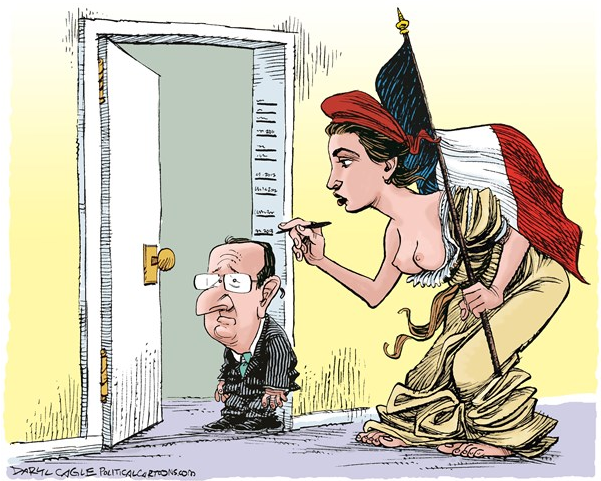
Shrinking President Hollande
A pattern has emerged: as soon as a cutback is announced, it is followed by a protest which is followed by the cancellation or reduction of the cutback. Result: loss of credibility.

Halfway through his first five-year term, the president's standing in the polls has now reached a dismal 13 percent, the lowest ranking ever for a French president. He has lost the support of the left wing of his own Socialist party which has spawned a block of dissenters that threatens to change the balance of power in the Parliament during a Vote of Confidence there this week. Depending on the outcome, the ruling party may lose its narrow majority, in which case the specter of a referendum, new elections and co-habitation with the center-right UMP opposition party looms large.

TRIERWEILER BACK WITH A VENGEANCE

In the midst of all these problems, Valérie Trierweiler, former "first lady" and live-in partner of President Hollande for the past nine years who was brutally dumped in January, has come out with a score-settling book entitled Merci Pour Ce Moment - her answer to the curt 18-word statement that François Hollande personally telephoned to AFP, announcing that he had ended his relationship with Ms. Trierweiler (blog 1/30/2014). The book depicts Hollande as a cold and calculating man whose focus in life has always been his own political advancement and who lost his humanity once he reached the presidency. He was disparaging about Valérie's humble background and called her family "no fun". Other, pettier, revelations concern his love of fancy restaurants and luxury hotels. But what really hurt Hollande was the statement that he, an avowed socialist, "does not like the poor and refers to them as the toothless ones". In what sounds like an overreaction, Hollande called this a lie and "a blow to my entire life". In Le Nouvel Observateur of 11 September he talks at length about his total devotion to the poor, from his high-school days on throughout his years of higher education and his entire political career. "I have always served the poor", he assures, and goes so far as to call the poor his raison d'être. As a socialist who has publicly stated that he dislikes the rich and who during his presidential campaign against "bling-bling" Nicolas Sarkozy pointed out that Sarkozy wears a Rolex watch ("I wear a Swatch"), not liking the poor does sound like treason.


No comment from Hollande about the matter of his ungentlemanly "dismissal" of Trierweiler, his alleged attempts over the next few months to win her back with bouquets of red roses, dinner invitations, and a stream of text messages ("one day he left me as many as 29 messages"), or his secret nighttime visits - helmeted and on a scooter - to new lover Julie Gayet, which had people tittering for weeks. He may have dismissed this as petty gossip, but being called a bad socialist really went too far.

Trierweiler never recovered from the backlash to her jealous Twitter outburst against Ségolène Royal, Hollande's previous partner and mother of his four children, when in 2012 she supported Royal's opponent in a senate race. Public sympathy went to Royal and shifted back only slightly when Trierweiler was boorishly repudiated by Hollande in full view of the world.

The appearance of Merci Pour Ce Moment created a sensation: a first printing of 200,000 copies sold out in a matter of days and another 200,000 copies are currently being distributed. Public opinion about Trierweiler is divided, with some calling the book an act of revenge by a woman scorned, while others see it as a predictable response to the needlessly public humiliation she suffered at the hands of a selfish womanizer who cast her aside for a younger rival. Amazon has announced that Merci Pour Ce Moment has become an instant bestseller, topping "Forty Shades of Grey" as the most-sold book in France so far. The English version will be available in October.


TRADER MEETS COMMUNISTS


Mélenchon welcomes Kerviel
In another Only-in-France moment, convicted trader Jerôme Kerviel, 37, who lost nearly €5 billion in risky derivative bets for his employer Société Générale in 2008, was warmly welcomed at the Communist Party-organized Fête de l'Humanité, an annual festival for French and international left-wing political groups held in a Paris suburb. Condemned to five years' imprisonment (two suspended) and released from prison only days ago with an electronic ankle bracelet and a night curfew, a happy Kerviel embraced Jean-Luc Mélenchon, founder and until recently co-president of the Left Party, and thanked him for his "unfailing support through my darkest moments". Mélenchon in turn compared Kerviel to Captain Alfred Dreyfus: "the innocent victim of a corrupt system - in this case the all-powerful world of finance that ultimately makes victims of all of us citizens and taxpayers". The unlikely bedfellows were cheered as they promised to fight together for more market regulation. 

Société Générale denies that it knew of the risky trades but Kerviel maintains that his bosses were aware of his actions and gave their tacit approval, later making him the scapegoat for the bank. During his trial he received wide support from a variety of leftist organizations who saw the Kerviel case as a symbol of the wider failings of the financial system.

The three-day Fête de l'Humanité was founded in 1930 and has been held every year with the exception of the war years 1940-1944. It is a popular mix of left-wing politics and a festival of music, food and wine, and draws many thousands of participants.


STRIKES OF THE WEEK

After spending two weeks in the rather less excitable north of Europe, I came back to an agitated France where this week alone several strikes have been called:  Pilots for Air France-KLM kicked off a week-long strike starting on Monday 9/15, accusing the airline of shifting jobs and operations to their low-cost carrier Transavia to fight growing competition from popular budget carriers Easyjet and Ryan Air.

That same Monday, the French "Huissiers de justice" (bailiffs) went on strike, to be followed on Wednesday by the French "Notaires" (civil-law notaries) who plan to march in Paris against the proposed reforms of their "regulated" profession. The Huissiers announced that there would be no hearings and no process serving for a week, hoping to temporarily paralyze the French judicial system.
Of the several hundred recognized professions in France, the Finance Ministry is currently focusing on 37 "privileged" professions, i.e., those that are in a monopoly position and can set high fees. They include lawyers, notaires, commercial court clerks, bailiffs, certain health professionals, dental technicians, real estate agents, but also driving instructors.

The driving instructors will strike "for an unlimited time from 9/15 on" because they object to the government's proposed solution to reducing the long waits for a driving test by allowing certain gendarmes to assist in the testing. The waiting times in France are the longest in Europe, with an average of 98 days for re-taking the test after a first failure. A strike in June failed to produce results but caused 10,000 tests to be cancelled. This considerably worsened a situation which is said to be due to a lack of inspectors and too many regulations. The gendarme solution seems reasonable enough, but in France reason does not always prevail.


SAN FRANCISCO ESCAPADE

Filippetti and Montebourg
Paris Match magazine has just been sued for invasion of privacy by Arnaud Montebourg and Aurélie Filippetti, former ministers of Economy and Culture, respectively. The September 11 cover of the magazine features the couple taking a "selfie" during a private visit to San Francisco, described as a romantic interlude in the California sun. Perhaps to forget the sudden loss of their ministerial jobs? As much as they loved and needed the press in their work, they clearly love it less now that they are free.


WAIT AND CROSS FINGERS


Valls and Hollande, worried and waiting
As I hold my breath for the outcome of this week's Vote of Confidence in the Parliament, I am not sure whether it is better for Prime Minister Manuel Valls to win by a slight margin only to face a large group of disenchanted socialists in his own camp who are not likely to help him implement the needed reforms, or that new elections be called which will result in a co-habitation with the center-right UMP opposition party that is even less likely to go along with President Hollande's course of action.


One thing seems certain: whatever the outcome, we are looking at a bumpy road ahead.


Wednesday, August 27, 2014

GOVERNMENT FALLS


WHO SAID THAT IN AUGUST NOTHING EVER HAPPENS IN FRANCE?

While most of the French were still in snooze mode with nothing on their horizon but La Rentrée, when kids go back to school and parents back to work in early September, the low hum of French holiday life was suddenly shattered on August 25th when Prime Minister Manual Valls tendered his resignation and the government fell.


Dissenting ministers Montebourg and Hamon
The crisis was set off by two ministers of Hollande's government − Arnaud Montebourg (Economy) and Benoît Hamon (Education) − who a day earlier had publicly denounced the economic policy of their president with its emphasis on austerity and cuts in public spending. Both Montebourg and Hamon belong to the left fringe of the Socialist Party, which objects to Hollande's Pacte de Responsabilité (tax cuts for businesses to stimulate hiring) without tax relief for the people, and accuses him of lacking a clear strategy to deal with the deteriorating economic situation of the country.

This was one attack too many by "loose cannon" Montebourg, also referred to as Le Coq Français, who is known for his anti-Europe and anti-globalization leanings. Both Montebourg and Hamon were fired, followed by Culture Minister Aurélie Filippetti who resigned in protest against Hollande's cutbacks in her department. After the shocking results of the European elections in March where the French Socialist party took a severe beating, the then-Minister of Ecology, Cécile Duflot, resigned from her post over strong ideological differences with Mr. Hollande.
[She was replaced by Ségolène Royal, Hollande's ex, who was happy to get back in government and obliged by canceling the Ecotax which Hollande had found too difficult to implement.] 
Duflot has since published a book wherein she harshly criticizes François Hollande's veering to the right and away from his socialist principles and promises.

Hollande with Emmanuel Macron, his new Economy Minister
With the Party in disarray, Manuel Valls, who was named Prime Minister less than five months ago when he replaced the too-timid Jean-Marc Ayrault, quickly appointed three new ministers (Economy, Education and Culture) and managed to retain perfect parity with eight male and eight female ministers. It is the third government of this year and President Hollande's last chance. If he does not find enough backing in the Parliament for his programs, Hollande may be forced to call for new elections and the result will be co-habitation with the opposition until the end of his term in 2017. 

With his popularity at a new low (17% in the IFOP poll of August 24), unemployment still rising (up another 0,8% in July), and the economy at a total standstill (0% growth in the first sixth months of 2014), President Hollande is in a bad spot.

The word amateurism is again on everybody's lips, as are his indecisiveness and lack of leadership. While Hollande has reiterated that he will not change his chosen course for economic recovery, it will be up to Prime Minister Valls, and his new Cabinet freed of dissenters, to rally the troops around the President's Pacte de Responsabilité and the common cause of economic growth.


Halfway through President Hollande's first term with its creation of such programs as the Pacte de Competitivité and its Choc de Simplification, intended to make French companies more competitive and reduce the complexity and paperwork of doing business here, it may be a cruel coincidence that just this week an article in The New York Times illustrated how little effect these programs have had so far and how the "old ways" to which the French cling like life rafts obstruct any attempts at simplification or competition.


As Suzanne Daley writes in the August 23 International New York Times (*), two young French business school graduates have been trying to open a driving school in Paris that with the help of computer classes and freelance instructors would provide a way to obtain a French driver's license in much less time and at much lower cost than the current system allows. They have run into a wall of regulations and are still waiting to obtain a license to operate from the local Préfecture which simply does not reply. Having complied with all the demands of this "regulated profession" the young entrepreneurs are not welcome among the expensive traditional schools (with waiting times of a year or more for the sparsely allocated exams) who feel that the newcomers are "breaking the rules" and are a threat to the old ways. The Choc de Simplification has not been felt in this area of business.  


Permis de conduire, old and new version
On a personal note I can add that my husband and I have obtained a French driver's license the old way at great mental and monetary cost. Many foreigners settling in France can get a French license in exchange for their valid foreign one, provided that their country has a reciprocity agreement with France. The US does, except for the District of Columbia, where we came from, and a few other States where French licenses are not recognized. Consequently, people from those States have to get a French license with all that implies:  at least 20 classes of driving theory (in French, of course) before you can take a driving test of which there are only a few per year per school. When your number finally comes up you take a zero-tolerance test in a stick-shift car without a right-hand rearview mirror, with the curious French explanation that a rearview mirror is only to be used in addition to your turning your head to see what's behind you.

I passed on the first try but my husband, who had been driving for more than 45 years in different countries, failed twice and finally passed on his third try. It was a costly and frustrating experience but, if it's any consolation, you only need to do this once. A French driver's license is issued for life! Another exception française, and incomprehensible in this over-regulated country where an 80-year-old can still drive with his license issued at age 18 (and presumably with his photo of age 18).
Go figure.

President Hollande may be making an attempt to reduce the mountain of rules and regulations in France that makes doing business here so frustrating and sends young people running to London, but in the true French tradition he also tries to please everybody (read: all those threatened by change) and ends up pleasing nobody.  The "Choc de Simplification" has run headlong into the wall of regulations and died of a brain injury.  R.I.P.

(*) Read the International NY Times article here:


Sunday, August 3, 2014

BUSY JULY; FIRST CHASSÉ-CROISÉ; BAD NEWS A-COMING; FIRST WORLD WAR; HOLIDAYS

BYE-BYE BUSY JULY

The hectic month of July is behind us:  operas, concerts, conferences and master classes in Aix were followed by four wonderful plays in Avignon and a sigh of relief that in the end the social conflict of the Intermittents did relatively little damage to these two main summer festivals. The source of the conflict, however, remains unresolved for now and will have to be addressed before year-end if the 2015 festival season is to be saved.  We cross our fingers.

The highlight of the 2014 Avignon season was probably the 18-hour-long performance of Shakespeare's Henry VI that drew a sell-out crowd from 10AM to almost 6AM the next day. For every one of its three shows! With five interruptions of one hour each, the exhausted but euphoric actors finished their marathon performance to a long standing ovation of an admiring public most of whom had stayed until the end. "Better than Game of Thrones" said one young spectator.

The newly nominated Festival Director, author-actor-director Olivier Py, summed up his first season this way: "It was a stressful time but it was beautiful". It was also costly, since the twelve performances cancelled due to strikes cost the Festival €300,000 in lost ticket sales, something that did not unduly worry the Avignon regulars who generally support the intermittents and vowed to be back next year, come what may.

Similarly, Bernard Foccroule, Director of the Opera Festival in Aix-en-Provence, declared himself satisfied with the 2014 season that despite a difficult start and two canceled performances managed to bring the Festival back into the black after a dip into the red last year. With ticket sales of close to 95 percent this year, things look good for next year when some BIG names are on the program, such as Sir Simon Rattle, Peter Sellars, the talented Katie Mitchell and others.


FIRST CHASSÉ-CROISÉ

Meanwhile, the first big chassé-croisé of the summer, when juillettistes and aoûtiens (July and August vacationers) cross each other coming and going on the north-south highways of France, broke all records on "black" Saturday, August 2nd, with hundreds of miles of traffic backups on all major north-south roads and blistering waits of up to one hour and a half at toll stations. It's a familiar sight on this biggest annual holiday weekend, yet nobody seems willing to forego one day of a holiday rental. Similar difficulties are to be expected every Saturday of August in the southward direction, with another "black" peak on Saturday 16 August in both north and south directions. Don't say I didn't warn you.


BAD NEWS A-COMING

A surprisingly optimistic President Hollande in his July 14th television interview was followed last week by a rather pessimistic Prime Minister Manuel Valls who − before the 2-week summer break of government ministers − announced that the post-holiday return (la Rentrée) will be a difficult one in economic terms. For the eighth month in a row unemployment figures rose in June, and the effects of
Manuel Valls, worried
the Pacte de Responsabilité (blog January 5, 2014) between the government and French business leaders have yet to be seen. Nevertheless, this Pacte is the right government response to youth unemployment, according to Valls, who further warned of a risk of deflation before things will change for the better. Reforms, reforms, reforms - that is what we need and what we are working on, he said, as he asked for people to be patient. "We are working hard and we will succeed".

As members of the Cabinet each went their way on a 2-week holiday "in France and within several hours from Paris so as to be available", François Hollande is taking his own summer break at La Lanterne, the presidential retreat in Versailles, where he intends to celebrate his 60th birthday on August 12th with his children.


WORLD WAR ONE

Hartmannswillerkopf cemetery, Alsace
This month marks the one hundredth anniversary of the start of the First World War, called la Grande Guerre in France, which killed 18 million people. On August 3rd, for the first time ever, French President Hollande and German President Joachim Gauck met at the large WW-I cemetery in Hartmannswillerkopf, Alsace, where they honored the 30,000 French and German soldiers buried there. They signed a joint declaration and laid the first stone of a Franco-German memorial building to be opened in 2017. "The terrible battles fought here make of Hartmannswillerkopf a sacred site in memory of the sacrifice of those fallen here, and the new museum will stand as an emblem of Franco-German friendship and a symbol of its reconciliation", read the Declaration signed by both leaders. The meeting was sealed with a long embrace between the two men. 

French and German presidents, holding hands


(Am I the only one to think that this looked a bit forced? The Germans, like the Dutch, are not huggers and both men seemed to be following a script for the journalists and photographers). 


HOLIDAYS

During this government recess and with most of the French on vacation, the month of August tends to be quiet, not to say somnolent. In fact, I feel a bit somnolent myself and will sign off here with a promise to report back to you as soon as everyone starts stirring again. 

As I climb into my hammock, is that a distant plane I am hearing?  Or a buzzing fly?  Or my buzzing cell phone?  Or....  ZZZZZZZZZZZZzzzzz.


Monday, July 21, 2014

SUMMER HEAT, INTERMITTENTS, HOLIDAYS, SARKOZY, BERLUSCONI, TOUR DE FRANCE

HEATED SUMMER

It's been an agitated summer so far with strikes and disturbances at several summer festivals, revelations of financial misconduct within the UMP opposition party, a surprisingly long and tough hearing of former president Sarkozy by French prosecutors, and the Tour de France off to a chaotic start. 

The INTERMITTENTS DU SPECTACLE (temps of the entertainment business) made good on some of their threats (blog June 15) and closed down the première of the Avignon theatre festival at the famous Palais des Papes and a number of other shows thereafter. In spite of an initial positive gesture from the government in response to the strikers' demands, a hard-core group of protesters shut down festivals in Montpellier, Marseilles, Uzès, and elsewhere, and at times the police had to intervene, particularly in a highly charged Avignon where Minister of Culture Aurélie Filippetti was shouted down by hecklers and the mood turned ugly.

In Aix-en-Provence, after a difficult start with one opera cancelled and another one disturbed, a compromise was reached:  the opera festival management distributed pamphlets and prominently displayed large banners in support of the intermittents at the four opera venues in town. In addition, they allowed the temps to present their case on stage at the beginning of each performance − generally to enthusiastic applause of the French audience and bewildered looks from foreign visitors.

At the 2014 International Opera Awards in London on April 7th, the festival of Aix-en-Provence was named "Best Opera Festival in Europe" − a prestigious distinction in a crowded field and proof of its increasingly wide resonance abroad. This month-long event produces €65 million in revenues for the region, approximately half of it for the city of Aix-en-Provence alone. Cancelling this festival would not only have disastrous financial consequences but would severely damage its reputation outside France, where less tolerance can be expected for the salary issues of the intermittents.   


AND AWAY WE GO...


None of this unrest has slowed down the holiday departures in France, when people leave the cities en masse, usually towards the Atlantic and Mediterranean coasts. Every weekend throughout July and August is a "weekend rouge" or "noir" on traffic-choked major highways, as hordes of vacationers − like lemmings − make their way to the sea. While the young splash around in pools or at beaches, their parents settle into their lounge chairs to read magazines or the summer best sellers that have been discussed and recommended in the press.


Yes, the French still haul stacks of books to their summer retreats and, with the exception of some youngsters, still vastly favor paper books over the electronic kind − perhaps partly due to a government policy that prohibits any bookseller from giving more than a 5 percent discount on the cover price of a book, thus leveling the playing field for small and large bookshops. This year, the French government added an "anti-Amazon" law that bans free shipping on online book sales in France. This policy is meant to protect the smaller bookstores from foreign giants who can afford to sell at a loss and threaten the very survival of the French traditional independent bookseller. Amazon has responded with a shipping price of one cent, and there will surely be some more legal skirmishing. But while the French may appreciate supermarkets, they will fight to maintain their less "efficient" but far more satisfying farmers' markets. Product quality and human contact prevail here, as they do in the traditional bookshop where browsing and knowledgeable employees enhance the experience of buying books. With a still robust market of more than 3500 bookshops in France (including 800 small independents), French brick-and-mortar bookstores may have a better chance than others to resist online book sellers. But for how long? 


SARKOZY

After spending 15 hours in police custody on July 1st, former president Nicolas Sarkozy was formally charged with corruption and abuse of power following a number of wiretapped conversations with his lawyer on his private cell phone. These revealed that information concerning his pending Bétancourt case (blog March 17) was being leaked to him by a lawyer at the Paris Court of Appeals who hoped to obtain a prominent position in Monaco with Sarkozy's help. Within hours of his long ordeal, a combative Nicolas Sarkozy appeared on national television to accuse the two prosecuting judges of clear bias, unnecessary humiliation, and building their case on illegally obtained information (lawyer-client privilege). Even if Sarkozy may be proven right, this episode still further erodes his chances of a possible presidential comeback in 2017.


Nicolas Sarkozy
Meanwhile, his UMP party continues to be weakened by internal scandals that have already led to the resignation of party leader Jean-François Copé over the Bygmalion affair (blog June 1). A financial audit has now revealed that the UMP is €80 million in debt, part of it incurred to finance the Copé couple's lavish lifestyle and pay for excessive salaries for the top managers. There are also rumors of a secret fund for presidential campaign expenses beyond the legally allowed limit. A triumvirate of three former prime ministers has taken over the leadership of the party until a new leader can be elected in October. Nicolas Sarkozy's backers are still hopeful that their man may return and, in the absence of any strong UMP candidate on the horizon, they may get their wish.


Old (left) and new glasses
Elsewhere in the political arena, President Hollande's dismal approval rating remains at 18 percent, the lowest ever recorded for a French president, according to an IFOP opinion poll published on June 4th. In a televised interview on Bastille Day, July 14th, he seemed to be in denial of the reality when he announced that the long-awaited economic recovery is there. If nobody has been able to see any sign of it so far, it is because "it is very weak, but it is there", according to the president. Neither his optimism nor his new eye glasses ("less intellectual") were convincing. In fact, the president's horn-rimmed new specs turned out to be made in Denmark, which caused the angry accusation of French frame manufacturers that Hollande is not living up to his government's "Buy French" campaign. Truly, the man can't win.


BERLUSCONI

One man who can and did win was Silvio Berlusconi who, on appeal, was acquitted of the charges of paying for sex with a minor and abuse of power. The judge apparently accepted Berlusconi's testimony that he thought the then-underage prostitute "Ruby" was over eighteen. Known for his harsh opinion of the Italian justice system, this time a jubilant Berlusconi commented that "the vast majority of Italian magistrates do their job quietly and with admirable impartiality and rigor". The ruling by the Appeals Court overturns his lifetime ban on holding political office, but may have little effect given Berlusconi's age and the fact that he is still on trial for political corruption at a court in Naples and for witness tampering in Milan.


TOUR DE FRANCE

This year the Tour de France has been plagued by a series of accidents that knocked several big-name riders out of the race early on. Mark Cavendish crashed out on the very first day in his native Yorkshire, and when the Tour hit French soil on day four, heavy rain and wind caused multiple spills on the slippery cobblestone roads, resulting in a number of broken bones. Among the victims were last year's winner Chris Froome, and former winners Alberto Contador and Andy Schleck. There are now no former Tour winners left in the remaining stages.


HAVE A HAPPY SUMMER ...   


AND KEEP COOL!