Thursday, January 19, 2012

Happy New Year, Kings' cake, DSK-Sinclair, French Juries, Lotteries, Truffle Wars, Marseilles, Calanques

HAPPY NEW YEAR -- Santé et Bonheur pour tous!!

So it's 2012 already. Ouch! The older I get the shorter the years seem to get.
With a new year that's barely begun, I'll dip into the end of last year for my first item: a strike. Yawn... You're right, but this one produced a surprising reaction from the government. The security personnel at airports nationwide decided to strike just before Christmas, which caused the cancellation of numerous flights and the delay of others. This is the busiest air-travel time within France when families gather for Christmas holidays, and the disturbance was keenly felt in those long lines that formed at airport counters. Yet, as so often before, I found the French extremely tolerant and few of them took their anger out on the strikers whose right to strike is sacrosanct even though their timing was not much appreciated. After a few days, the government sent in the gendarmes to take over the security checks and things returned to normal. Explained president Sarkozy on television: "It is unacceptable that strikers take the French people hostage at a time of holidays when families get together." Of course, I remember many strikes against cutbacks in education or in health care, or even among judges and lawyers who took to the streets against government encroachment on their independence -- all well justified and widely supported despite the discomfort they caused -- but never before had a president declared this "hostage taking" unacceptable. Then again, that was not during a family holiday and not just before a presidential election...

Airport security agents on strike


GOOD NEWS, SORT OF ...

The first newspapers of the year tend to be predictable in their listing of last year's accomplishments, although some of those are rather self-congratulatory. For instance "This year, fewer road fatalities than last New Year's Eve!" loses a bit of its luster when you know that France has the worst record in Europe and that the slightly better figure of this year is mostly due to the increased number of gendarmes on the roads and the brand-new law that may hold bar owners co-responsible for drunk driving. All bars and night clubs that close after 2 a.m. are now equipped with alcohol-test devices for clients to use before they leave the bar and when this indicates a level beyond the legal limit for driving, the car keys are withheld and the client will be driven home by volunteers or by taxi. It has been proven to be effective, at least on New Year's Eve, but the cynics among us will wonder how soon this will go the way of most New Year's resolutions.  


LA FEVE

On Epiphany Day, January 6th, many countries, including France, celebrate the arrival of the three Magi with a traditional cake (called the Galette des Rois) that contains a fava bean (fève in French). The person who gets the bean will be king or queen for the day. This tradition is alive and well but in France the fava bean has been replaced by a porcelain token, still called a fève but no longer a bean, that can take the shape of the baby Jesus from the nativity scene, or a small santon, or a little fantaisie such as a mini delivery van with the name of the bakery painted on it. Over time, certain bakeries have distinguished themselves with their original tokens, but this year two bakeries made the newspapers. In the village of Vedène in the Vaucluse, a patissier introduced the "Galette Coquine" which contains one of a dozen different positions of the Kama Sutra. He also announced that once a week one of his galettes coquines will contain a little penis of pure gold! Collectors - get in line.

Fèves:  Naughty...
... and Nice

Meanwhile, in Aix-en-Provence, baker Serge Richier announced that he baked 1500 traditional galettes des Rois of which only one contained a real treasure:  a genuine English gold sovereign valued at more than 300 euros! The 1500 galettes were sold out in three days, which led the baker to announce that he would repeat his offer for St. Valentine's Day -- this time with a necklace of similar value, to be reclaimed by the person who presents the fève created especially for this occasion.   


STRAUSS-KAHN Saga - cont'd: 

Anne Sinclair, wife of you-know-who, has been appointed head of the new Paris bureau of The Huffington Post, renowned international blog. Well-known in her own right as a television journalist in France before the g(l)ory days of DSK, this new post should give her something to do other than standing by her man. And did you know that Sinclair was voted "Woman of the Year 2011" by French feminist website Terrafemina? Chosen for her "courage and tenacity" she inched past Christine Lagarde, current head of the IMF who replaced Dominique Strauss-Kahn. Hillary Clinton took third place. Speaking of DSK, he is slowly re-emerging in the socio-political circles in Paris where he used to shine. Just yesterday, January 11th, he and his wife were seen attending the screening in a movie house on the Champs Elysées of the about-to-be-released French television series "The Men behind the Scenes" and it looked just like the old days:  the famous couple, all smiles, were allowed to take their well-placed seats before the others and were quickly surrounded by old friends, PR people, and certain politicians who had cautiously kept their mouth shut during the scandal. And in mid-December DSK had been invited to an economic forum organized by "NetEase" in Peking where his 35-minute speech and subsequent interview were widely covered by international television. His pessimism about "Europe" drew a lot of attention here as well as his comment that "Nicolas Sarkozy and Angela Merkel are not on the same page" which creates grave problems in the eurozone. Is DSK getting back into the public arena? Let's say that for now he is back from the brink, at least.


JURY TRIALS IN FRANCE

As of this month France will be testing a new jury system, initially only in the cities of Toulouse and Dijon, in order to increase lay participation in criminal trials. Two jurors will assist three magistrates in cases punishable by five to ten years in prison (sexual assault etc.) in correctional courts. Heretofore, the French jury system was limited to cases before the Cours d'Assises (higher courts that deal with serious crimes such as murder) where nine jurors assist three investigating judges. If the test results are favorable, the new jury system will become applicable throughout the country as of 2014.


FRIDAY, JANUARY 13th

Superstition persists on Friday the thirteenth and in most countries with a national lottery system people will buy more tickets on a Friday the thirteenth than any other day. This is certainly true in France, where lines will form today in front of the bureaux de Tabac (places where cigarettes are sold) where people buy these state lottery tickets. The radio announced this morning that the year 2012 will have three Fridays the thirteenth. Yoopee for the gamblers.

El Gordo winners


This reminds me of El Gordo (The Fat One) in Spain, named after the top prize in the Spanish state lottery. Tradition has it that everybody in Spain buys lottery tickets at Christmas time, for themselves and for gifts to friends or family, which makes this the richest lottery in the world. I once witnessed this lottery fervor from my hotel window in Madrid when I saw a queue of people stretching for more than a block across the street. In these harsh economic times I thought they were lining up at an unemployment office, but it turned out that this was one of the places where tickets for El Gordo were sold and that many people pay someone to stand in line for them. This was early December and many days yet to go before the drawing on December 22nd, but these long queues would be a daily sight until the closing. For Christmas 2011 El Gordo's pot grew to 2.5 billion euros ($3.29 billion) and the first prize of more than 700 million euros was won by the small town of El Grañén (pop. 2100) where 1800 people had pooled their resources to buy shares in the top prize. In one fell swoop each of the 1800 participants received 400,000 euros for their 20-euro tickets, a particularly happy outcome for this hard-hit town where several businesses had closed and unemployment was high. A more-than-merry Christmas for El Grañén! And for the State, which does not tax these winnings but retains 30% of the total sum spent on tickets -- at more than 1 billion euros, one of the biggest takes since El Gordo was launched in 1812.   


TRUFFLE WARS

Truffles have long been a delicacy for which people are willing to pay a high price (1000 euros per kilo), but it's no longer just gourmets who go after them but thieves as well. An increasing number of truffières (truffle farms) are being plagued by robbers who come with sniffing dogs to dig up truffles in the dead of night. In two of the most "fertile" truffle areas of the Drôme and the Vaucluse regions, truffle farmers are now being helped by gendarmes equipped with special silent four-wheel-drive vehicles and night-vision goggles who patrol the back roads for these poachers. A number of arrests have been made and the gendarmerie has promised to keep up this increased surveillance until the end of the truffle season in mid-March. Between the wild boars in the area and this new human plague, some of these farmers are getting itchy trigger fingers, and in December of 2010 a truffle thief was fatally shot by a farmer.


MARSEILLE, TOUJOURS MARSEILLE...  (*)
(yes, Marseille takes an 's' only in English)

In 2013 the city of Marseilles will be the Cultural Capital of Europe. An honor, but quite a challenge in view of the size and complexity of some of the planned projects that are yet to be completed this year. There will be new buildings, new tunnels, new infrastructures, new green spaces, and 400 planned cultural events over 365 days for the 2 million tourists expected. The largest single new building currently under construction is the MUCEM (Museum of Civilizations of Europe and the Mediterranean) that is rising very slowly on the edge of the Old Port of Marseilles and has just hit another snag. This time, an unexploded American World-War II bomb was found that caused all further excavation to be stopped. The 500-lb device packed with explosives was located in a densely populated area and surrounded by some of the greatest historical treasures of the city. Before removing the bomb, extensive precautions had to be taken in a perimeter of 800 meters, including the evacuation of 4,300 people and the home confinement of 10,000 others, closing two nursery schools, blocking roads and tunnels, and stopping all commerce including shipping (cruise ships to be diverted) for a duration of 6 hours. Finally, on January 18th all services were coordinated and the bomb squad could go to work. It successfully removed the bomb, took it out to sea and exploded it 30 km off-shore. When the all-clear sounded, the locals heaved a sigh of relief, including the architect who can now resume this big project that is to be delivered in January 2013. Let's hope he won't be hitting some Roman ruin in the meantime.


MUCEM in Marseilles

CALANQUES

The stretch of coastline between Marseilles and Cassis is blessed with calanques - crystal-clear inlets flanked by cliffs and sometimes with small sandy beaches. These calanques can only be accessed by sailboats or by steep hiking trails, which saves them from overcrowding like most Mediterranean beaches. A project has been introduced last year, soon to be voted on, to turn this precious stretch of coast into a National Park in order to guarantee its preservation. Environmentalists and a good part of the local population applaud the initiative, but as the vote approaches political cracks are appearing, opposing groups are forming, the fishermen of Marseilles want guarantees that their fishing rights won't be interfered with, one local community is threatening to withdraw, and non-negotiables are being negotiated. And so it goes...

Calanque d'En-Vau


(*)  To read a special chapter on Marseilles in Taking Root in Provence, click here.


Wednesday, December 7, 2011

The Americans are Coming! Le Train Bleu, Christmas Here and There, DSK

What's this??
After the invasion of cupcakes, a new American food item is currently making inroads into the French food chain: bagels. This most American of breads is the newest kid on the block and joins donuts, pretzels (called "bretzels" here), cheesecake and of course "le 'amburger" and "le 'ot dog" as a mid-day meal that is much appreciated by youngsters, among them the numerous American students in the area. In Aix-en-Provence alone, two bagel shops have opened - Bagel Story and Comptoir du Bagel - that are doing steady business and seem to have found their niche. Both shops, one in the old center of Aix, the other on the outskirts, have their bread brought in from New York, and both have a rather large "bagel menu." Priced around 5 euros, the bagel is not cheap (about $7.00) but with its choice toppings makes a meal at lunchtime where it is currently competing with panini and that eternal old-timer: the "jambon-beurre."

A recent French newspaper article on this item claimed that the bagel was invented in 1683 by a Viennese baker to honor king Jan III Sobieski of Poland-Lithuania who beat back the invading Ottoman Turks from the gates of Vienna with a charge of his cavalry. The somewhat unevenly round bread with a hole in the middle is meant to represent a stirrup - a "Bügel" in German. I'll accept this French version, even though several other interpretations exist that claim even older origins than this one, mostly with a Yiddish etymology. A rose by any other name...


LE TRAIN BLEU

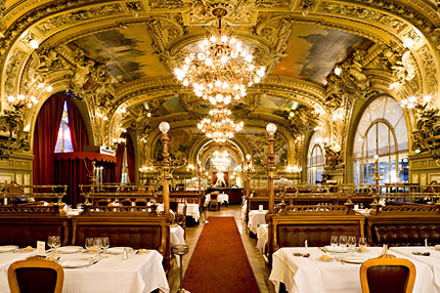
On a recent stopover in Paris we had lunch at the restaurant Le Train Bleu at the Gare de Lyon. We tend to schedule our arrivals or departures on the TGV Aix-Paris in such a way that a leisurely lunch at this spectacular restaurant can be included in the trip. There certainly is better food to be found in Paris, but I doubt that there is a more elaborate restaurant decor anywhere. The eyes have it here - and the taste buds won't complain either, perhaps because the eyes are so busy taking in the surroundings. The Gare de Lyon station was built as part of the Paris Exhibition of 1900, and a year later its Buffet (restaurant) was opened by the then-President of France. The most distinctive feature of Le Train Bleu is its Belle Epoque decor, including painted ceilings and murals depicting different sites along the north-south railway network. There are 41 paintings in all, covering every square inch of the large main dining room and the Gold Room, which after suffering the effects of years of smoke fumes from the steam engines have recently been restored to their original state. So exceptional is this restaurant that in 1972 it was declared Monument Historique by Minister of Culture André Malraux.

Le Train Bleu, Paris

And the food? The formal dining room with its white tablecloths is rather pricey and especially appreciated by local businessmen, but the cuisine can be uneven. Even so, one stand-out dessert that never fails is their Baba-au-Rhum which, the waiter will tell you, was invented right here. It is generously dosed with rum when served, and the bottle is left on your table should you want another soak. For those travelers who only wish to have a quick bite and coffee (perhaps with a slice of "Grumble Cake" from their menu), a simpler room is available as well as a clubby side room with leather chesterfields and fauteuils. This exceptional example of Belle Epoque style is well worth a visit, whether you eat there or not.

CHRISTMAS HERE AND THERE

Christmas means pretty lights and street decorations, especially in the capital cities of the Western world and in their department stores. Paris, the city of light, does a pretty good job, but for my taste the Anglo-Saxons with their extensive use of natural greenery in wreaths and garlands and sprays take the prize.
London Ritz
In London last week I had a chance to see the magnificent Christmas decor at The Ritz hotel, both inside and out, and was struck by the perfect balance between opulence and restraint, with colorfully trimmed trees and lush garlands inside, and simpler greenery lit by little white lights on the outside façade and along the covered gallery. Another beautiful display can be found at Harrod's food court, where each food genre (game, fish, chocolates etc.) has its own Christmas decor. And who can forget the stunning window displays at Saks Fifth Avenue in NYC? I suspect that these "private" enterprises have bigger budgets than municipal treasuries, which may have suffered cutbacks. Yet, last year in Madrid, despite a severe financial crisis, I found the public Xmas decorations very impressive. All along one of the widest avenues brilliant, multi-colored disks hovered overhead and all the city squares had a large tree decorated by a different local artist. It was a dazzling display of creativity.

Paseo del Prado, Madrid

Coming back from London or Madrid at Christmastime to Aix-en-Provence (*) is a rude shock, not because this much smaller city cannot afford rich yuletide displays, but because it is increasingly favoring commercialism over the old traditions. From mid-November to the end of December, the Cours Mirabeau (the Champs Elysées of Aix) is taken over by a children's fair with merry-go-rounds, bumper cars, bungee cords, whistling reindeer trains, games with alarm-like whoops when a prize is won, and other divertissements that have no relation whatsoever to Christmas.

Cours Mirabeau
Aix-en-Provence
Between the long row of chalets selling trinkets on one side and the children's fair on the other side, the otherwise beautiful Cours is a noisy mess during the Xmas season. No Christmas tree here, no carols, no Santa Claus on the Cours or in department stores, no wreaths or stars - in short, no Christmas atmosphere. In this lay country, there is no public nativity scene and little reminder of the religious origins of Christmas, but the traditional Christmas tree came from Germany, after all, and has come to symbolize Christmas wherever it is celebrated. As for local Christmas decorations, let's just say that they are forgettable. Churches, on the other hand, often have a nativity scene peopled with hand-crafted Santons (sometimes life-sized) dressed in Provençal costume, and one local midnight Mass includes a real shepherd with a live flock of sheep.

Unfortunately, one recurring incident during the Christmas season is robberies. Oftentimes, warehouses are broken into at night and emptied of televisions, cell phones, toys and so on. The first such heist was just reported in the local newspaper:  27,000 bottles of Chateauneuf du Pape were stolen from their warehouse at Domaine Mayard. Lest we forget:  Christmas in France is mostly a matter of food and wine.

On a more positive note, the French Telethon, which is held annually in early December, hauled in a record number of pledges this year: nearly 87 million euros (12% more than last year). Throughout the year 2011, a total of more than 3.7 billion euros was donated to various causes in this country of about 65 million people, evidence once again that the French are among the most generous people in the world - even in difficult economic times.

For STRAUSS-KAHN followers - it has recently been rumored that he will be moving to Israel where he has been offered a position at the University of Tel Aviv. Presumably after he settles a little unfinished business in New York.

In wrapping up this month, I realize that I have come to the first anniversary of this blog. I'll allow myself a candle on my Sunday pastry and the wish that you have found it worth reading. If I am allowed another wee wish it would be that by your comments you will encourage me to go on - or discourage me, as the case may be. Truly, any comments or suggestions are welcome.

May you all have a Merry Christmas and a Happy and Peaceful New Year.

XXOOXX

 (*) Taking Root in Provence features a chapter on "Christmas in Provence." To take a look, click here.

Wednesday, November 16, 2011

G-20 Summit, Festival Image de Ville, Strauss-Kahn

G-20 Summit

The G-20 summit meeting that was held in Cannes November 3-4, 2011, had a touch of drama. This meeting, like all others of this caliber, was prepared well in advance with a well-defined agenda. But the euro-crisis interfered and a good part of the agenda was supplanted by the problem of Greece's sudden announcement on the summit's eve of a planned referendum on the question of whether or not it should stay in the Euro zone. Taken by surprise, "le couple Merkozy" (Merkel and Sarkozy) fiercely attacked Greek Prime Minister Papandreou for highjacking the G-20, and within days the referendum was dropped. Nevertheless, the acute difficulties of the eurozone took center stage and led the foreign leaders to conclude that "Europe must get its house in order" before any consideration can be given to financial assistance. This item, as well as the financial transactions tax proposed by Sarkozy, were deferred to next February -- a rather disappointing result for president Sarkozy who chaired this summit meeting and is facing re-election in 2012.


As if the Greek problem were not enough, shortly after the Cannes summit a new convulsion shook the eurozone, this time coming from Italy where Silvio Berlusconi finally ran out of tricks to hang on to power and lost a vote of confidence in Parliament that led to his resignation. The street received this news with a spontaneous explosion of joy and I am left with the indelible image of a full-throated choir outside the Parliament building singing Haendel's Halleluyah as the black limousine with a somber-faced Berlusconi drove away into the night, pushing through a furious crowd holding aloft signs of
Ladrone! and Buffone!

Next - bunga-bunga parties with pal
Putin in their adjoining estates in Sardinia?


Festival Image de Ville (*)

From 11-15 November 2011, Aix-en-Provence held its annual Festival Image de Ville which features architecture in one form or another in the presence of a "star architect." This year the subject was "La Rue" and what it represents in today's city, and the big architect was Christian de Portzamparc, noted urbanist and the first Frenchman to win the prestigious Pritzker prize (1994). Among his best-known projects are the Cité de la Musique in Paris, the Luxemburg Philharmonic Hall, the LVMH Tower in NYC, the new city of Almere in Holland, the Cidade de Musica in Rio de Janeiro. During four days of conferences and debates no less than 75 films (documentaries, shorts and full-length commercial films) were shown, all of which had a connection to The Street. The selection was wide and varied, including the recent Le Havre by Finnish filmmaker Aki Kaurismäki (2011), M by Fritz Lang (1931), La Zona by Mexican Rodrigo Piá (2007) and West Side Story by Robert Wise and Jerome Robbins (1961). Seeing and hearing West Side Story again made me a little "homesick" - so unmistakably American, from the vibrant score by Leonard Bernstein to the fabulous dances on Manhattan's streets - no-one else could have made this movie.
Philharmonic Hall, Luxemburg


Strauss-Kahn deeper and deeper in merde  


The DSK saga continues. As his future darkens under new sex allegations in the Carlton Hotel prostitution scandal that is currently being investigated in France, DSK is on the defensive again. Several French newspapers, reporting on DSK's alleged links to the Carlton Affair, have now added speculation over his marriage to wife Anne Sinclair. When the Carlton stories first surfaced, Strauss-Kahn immediately asked to be heard by investigators in order to put a stop to the damaging rumors and clear his name. To date he has not been heard, but suspicions are growing that the rumors were not unfounded. Even though prostitution is legal in France, the question of who paid for these services is at the heart of the matter and could result in charges against DSK, which would certainly be used in the civil case against him in New York.

Initially, his old friends and allies in the Socialist party took the "innocent until proven guilty" position, but several of them have since made clear that "too much is too much" and are now coming out against him, effectively killing any glimmer of hope for a return to public life that still might have existed.

Recent rumors of an impending divorce have been countered by DSK and his wife filing a lawsuit for invasion of privacy and complaints of "base voyeurism" and media lynching in the absence of any formal charges against him. Who could have imagined this turnaround for a man who mere months ago was the well-respected head of the IMF and the likely next president of France? Used to being surrounded by admirers and sycophants, today he cuts a lonely figure on his way to oblivion.  


(*)  For other festivals featured in Taking Root in Provence, click here.

Saturday, October 29, 2011

Halloween in France

Halloween in France

We are in holiday mode again with schools being closed the last week of October. Having just come back from their long summer breaks in early September, French children next get a week off for la Toussaint, All Saints Day. Many city dwellers pack up their family and leave for the countryside or the coast for a week "away." And, let's face it, with a starting level of 30 days vacation, the French have enough time off to do this several times a year. Traditionally, this is a time for family gatherings and for going to the cemetery to put flowers on family graves -- usually potted chrysanthemums which, by the way, are considered cemetery flowers here and are never to be given as gifts, especially not on hospital visits. Lately, however, Halloween has become part of this Fall holiday which, considering its Celtic origins, should be no surprise. Even though it still resembles more an at-home dress-up party with scary masks and costumes than the street event where American children go out ringing doorbells and trick-or-treating, French commercials are increasingly featuring Halloween themes, pastry shops are offering special desserts and candies, and pumpkin growers produce extra crops for jack-o'-lanterns. Yet, many French remain weary of commercialism and of the introduction of "American" celebrations. Is Halloween here to stay? The jury is still out...

Halloween in Paris


Strauss-Kahn in hot water again


A rather sordid scandal in Lille, involving organized prostitution in the luxury Carlton Hotel, has claimed its first victims. Police are investigating a prostitution ring that catered to high-flying businessmen and local officials and even supplied prostitutes for encounters in nearby Belgium. The hotel's PR manager and a French businessman are being held for questioning, and the local police commissioner has been reassigned to a lesser post in Paris, which gave him the opportunity to resign and take early retirement. But as the investigation continues, a new big-name client has surfaced:  Dominique Strauss-Kahn. It is claimed that DSK was offered prostitutes from the Carlton Hotel to join him, including most recently at the Sofitel hotel in New York City on the Friday preceding his Saturday assault on a maid in that hotel. DSK has requested to be heard by police as soon as possible "to put an end to the insinuations."


Sunday, October 23, 2011

Bullfights and Sodas

October 23, 2011

Bullfights

In front of the Roman arena of Nîmes stands a bronze statue of Nimeño II, the brilliant local torero (and brother of Nimeño I) who was severely injured by a Miura bull in 1989 which left him partly paralyzed. Two years after the accident he committed suicide. It is one of the dramatic stories that punctuate the history of tauromachy in France and in Spain, where an anti-corrida movement has been brewing for some time and has now come home to France.
When Catalonia recently outlawed bullfights on its territory and 20,000 aficionados packed the arena of Barcelona for a final corrida, supporters of tauromachy - in danger of losing other territories - began to organize demonstrations to safeguard corridas wherever strong interest still exists. Nîmes is one such place, and during its harvest Feria on September 18th the first clashes broke out between pro- and anti-bullfighting demonstrators. Taken by surprise, the pro forces could not prevent the opposition from "desecrating" the statue of Nimeño II which to many was going too far. So two days ago the pro-corrida fans gathered, three thousand strong, in front of the statue of Nimeño II and placed carnations at his feet. It was noted that many local politicians were present, which illustrates the importance of listening to the significant block of voters in this country represented by a political party called le Parti de la Chasse, Pêche, Nature et Traditions (CPNT). Tradition is not trifled with and change comes slowly here. I suspect that the huge Roman arenas in Arles and Nîmes, as well as the numerous smaller arenas throughout the southwest of France, won't go silent anytime soon.(*)
Homage to Nimeño II
Elected officials demonstrating in Nîmes


Sodas and Soft Drinks

In preparing its 2012 Budget, the French Ministry of Finance has announced that it will double the planned tax on sodas and sugar-enhanced soft drinks from 0.01 to 0.02 euro per can. The measure was accepted by the General Assembly and will be up for a global vote on October 25th. It is expected to be passed. This price hike would result in increased tax revenues of 240 million euros a year. These additional revenues will go toward filling the gap in the national health insurance coffers, the government explained.


Rugby Finals

France lost the World Cup Rugby by one point (7-8) against New Zealand in a well-fought match which, some say, the French dominated. It's at times like these that big guys cry, but when a few days later "Les Bleus" were welcomed back at the Place de la Concorde in Paris, where 10,000 fans shouted their support and appreciation for the captain and his players, spirits were restored and it almost seemed that they had brought back the World Cup themselves.

Winning rugby team: New Zealand's All Blacks

(*) To read about the Easter bullfights in Arles in Taking Root in Provence, click here.
Monday, October 17, 2011

Elections, Rugby, Pétanque, and Carlos Fuentes

Primary Elections

The Socialist party in France has decided to hold primary elections this year in order to choose among six candidates the one who will oppose incumbent President Sarkozy in April 2012. The first round on October 9th was won by François Hollande, followed by Martine Aubry. In the second round a week later, Hollande increased his lead and became the official Socialist candidate. Note that this was the first primary election ever in France, based on the American primaries which are cited as an example of voter participation in choosing a presidential candidate who was heretofore always appointed by the Party.

Primary debate Aubry-Hollande


Rugby

In the world of sports, France is currently in the ban of the World Cup Rugby that is taking place in New Zealand, where France will be facing the host country’s feared All Blacks in the finals on October 23rd. French fans are collectively holding their breath and won’t exhale until it’s all over. Stay tuned.


Pétanque

In the meantime, Marseilles has just announced that the next world championship Pétanque (also called Boules) will be held in Marseilles in October 2012. Little did I know that there was such a thing as a “world" championship for this sport, which resembles horseshoe throwing or the Italian bocce ball and is very popular in southern France. But in 2004 the French Ministry of Health and Sports declared Pétanque a “sport de haut niveau” which qualifies it for government subsidies, and since then the Fédératon Française de Pétanque has been working hard at changing the image of Boules as an old man’s hobby into one of a serious sport for all ages. No mention so far who the other contestants will be.

Pétanque championship Marseilles

Fête du Livre 2011

October is also the month for the Fête du Livre in Aix-en-Provence, where the municipal library organizes a four-day annual event that has brought numerous Nobel prize winners and other literary greats(*) to this book-loving city. This year, Mexican writer Carlos Fuentes was the guest of honor, who at age 83 continues to write and add to his considerable body of work. An engaging speaker and tireless participant in three days of conferences, he was joined by about a dozen younger Latin-American writers who acknowledged a debt to Fuentes’s work. Together with Colombian Garcia Marquez and Peruvian Vargas Llosa, Fuentes was declared one of the living monuments of Latin-American literature today. How lucky we are in Aix!


(*) To read about earlier guests at the Fête du Livre, including Philip Roth and Nobel prize winner Toni Morrison, described in Taking Root in Provence, click here.

Sunday, September 25, 2011

National Heritage Weekends

September 17-18 – National Heritage weekend

During the third weekend of September all French cities celebrate the “Journées du Patrimoine” when for 2 days many historic buildings that are normally closed to the public are opened for guided tours. In Paris this may include government buildings (Elysée Palace, including the Office of the President, the Palais du Luxembourg where the Senate resides, the General Assembly, Town Hall), some embassies or ambassadorial residences, theatres, libraries, or buildings of particular architectural importance both old and new. Initiated by the French Ministry of Culture in 1983, these Heritage Days have become very popular, as witnessed by the long lines that inevitably form at the designated sites, and have since been adopted in many other European countries. 

Palais du Luxembourg 

Inside Palais du Luxembourg
The Palais du Luxembourg was built by Marie de Médicis, mother of king Louis XIII, in the style of the Palazzo Pitti of her native Florence. As a direct result of the French Revolution these "private" royal properties reverted back to the State and are today accessible to the people in whose name they are used.