Sunday, June 23, 2013

GAY MARRIAGE AFTERMATH, FLOODS, BONJOUR TRISTESSE, ENGLISH, INSULT


GAY MARRIAGE AFTERMATH

On May 18th the French parliament signed the controversial Mariage Pour Tous proposal into law, making France the 14th country to legalize same-sex marriage. It had been a long and fierce battle that opposed those in favor, who considered this a human rights issue above all, and those against, who represented the more conservative factions including many Catholics. Soon after the new law was signed, 78-year-old right-wing historian Dominique Venner shot and killed himself in front of the altar in Notre Dame cathedral, causing the evacuation of 1500 people. Earlier that day Venner had written on his blog that he despaired of the failure of peaceful mass protests against same-sex marriage and spoke of the need for "new spectacular and symbolic gestures to wake up the sleepwalkers and shake the anaesthetized consciousness".  


On May 29th the first gay marriage was celebrated in Montpellier by Mayor Hélène Mandroux who called this a historic moment not only for her city but for all of France, the country of Human Rights. Surprisingly, the event was extensively covered by the international press (e.g. Argentine newspapers, BBC, CNN, France 24). After all, France took this step years after some of its neighbors had done so, including Holland, Belgium, and Spain.

And yet, the world press was there in full force that day and the arguments for and against this legislation were rehashed again on all the main TV channels. The majority of the French, it appears, were in favor of gay marriage but not gay adoption, which was so fiercely contested that further protests and street marches were organized even after the law was signed. Unfortunately, during these protests a small group of extreme-right skinheads infiltrated the demonstrations, provoking skirmishes that often resulted in injuries and in destruction of property.

A side effect of this infiltration of neo-Nazi groups on the fringes of the gay-marriage issue was the increasingly violent clashes between the hard left of young anti-fascists and the extreme right of trouble-seeking skinheads which on June 6th resulted in the tragic death of a young Political Science student who was beaten to death by a group of skinheads. Words were exchanged at a private sale of Fred Perry T-shirts in a Paris apartment where 18-year old student Clément Méric and a few of his hard-left activist friends crossed some skinheads wearing "White Power" and "Blood and Honor" T-shirts. Once outside, the fight escalated on the busy street below. According to witnesses one of the neo-Nazis used a knuckleduster to knock down Méric who was then stomped to death in front of horrified bystanders.

Interior Minister Manuel Valls blamed the extreme-right group and expressed concern over the "dangerous discourse" of the past weeks over same-sex marriage, while Jean-Luc Mélenchon, left-wing former presidential candidate, warned that the growing popularity of Marine Le Pen's far-right Front National party had caused a number of extreme-right groups to flourish. Prime Minister Jean-Marc Ayrault, meanwhile, called for all groups of "fascist and neo-Nazi inspiration" to be broken up, which would include the far-right Génération Identitaire which last year occupied a mosque under construction in Poitiers in protest against the "Islamization" of France.

Clearly, the murder of Méric has polarized the political debate, leaving an uneasy tension in its wake.


FLOODS

Excessive rainfall and severe floods have plagued much of central Europe this past month, notably in Germany and Hungary. The Danube and Elbe rivers burst through their banks and caused extensive damage to property and crops. At least eighteen people were reported killed and many thousands had to be evacuated, 23,000 in the German city of Magdeburg alone. Chancellor Angela Merkel called on the Army to sandbag dikes and assist rescue workers. The cost of cleanup operations is estimated in the billions of euros.
Germany

Just days ago, heavy rains and melting snow from the Pyrenees formed raging floodwaters in south-western France that caused three deaths and inundated a number of villages as well as part of the town of Lourdes, where the famous grotto and the subterranean church were flooded and pilgrims had to be evacuated. The large Sanctuary of Notre Dame de Lourdes was closed to assess potential structural damage and pilgrimages have been temporarily suspended.

This has been the worst flooding in memory, topping water levels measured during the "flood of the century" in 2002. Extreme weather conditions are becoming more frequent, and according to the European Environment Agency (EEA) floods of this magnitude are likely to recur in Europe, partly due to climate change but also due to changes in land use and population increase. Hans Bruyninckx, Executive Director of the EEA, stated: "climate change will be an increasingly important factor, but in many cases flood risk is also the result of where and how we choose to live. Increases in costs of flooding in recent decades can be partly attributed to more people living in flood-prone areas".

Lourdes, France
Local governments are responsible for issuing building permits in flood-prone areas and we may hope that past mistakes will not be repeated, but combatting climate change demands international cooperation. Judging by the disappointing outcome of the last UN conference on climate change, held in Copenhagen in December 2009 and attended by 115 world leaders, we have a long way to go. After days of political bickering, the Copenhagen Accord turned out to be a "weak agreement" that contained no significant future benchmarks for climate control. Rome burns while our leaders fiddle... .


BONJOUR TRISTESSE?

"Bonjour Tristesse" reads the headline of a recent article by Mathieu Von Rohr in German weekly Der Spiegel. It referred to the economic and political decline of France and the "reality bubble", as Von Rohr terms it, that most of the French political class is living in.

Nearly all French leaders have been educated at the prestigious Ecole Nationale d'Administration (ENA), an institution with a quasi-monopoly of access to top-échelon jobs in the French civil service and entry into politics. Founded by General de Gaulle in 1945, ENA turns out approximately 100 graduates (called énarques) per year. This elite group, imbued with France's grandeur of days past, has been accused of being disconnected from reality, especially the diminished standing of France in the world. Not too surprising when daily reminders of this grandeur are everywhere and not only the president, but also the prime minister and most of his cabinet ministers occupy the grandest palaces of Paris which reflect a big, rich and powerful France.

The documentary "Pouvoir", shown recently in French movie theaters, seems to underline this point. Here is President Hollande in his daily routine at the Elysée Palace, surrounded by gilt and glitter and liveried lackeys who call out Le Président de la République! every time he enters a room. Director/producer Patrick Rotman had been given free access to François Hollande throughout the first eight months of his presidency, from the initial euphoria of his election to the first stirrings of discontent about his inadequate response to the nation's problems.

A depressed France sees record unemployment, a long-stagnant economy, factory closings, and uncompetitive labor costs on the one hand, and a patchwork of small remedies by a wavering president on the other. Past governments have failed to take decisive measures and it is ironic that it now befalls a Socialist president to implement the overdue cuts and deep reforms he had vowed to avoid. France has the highest public spending of all the EU members and its costly welfare model is no longer viable. The European Commission in Brussels had extended France's deadline for compliance by two years but is now threatening to issue warnings to implement the needed reforms. Worse yet, Germany has become the clear leader in Europe and is setting the tone.

Desperately looking for something positive, Hollande likes to remind us of his greatest success so far, that of sending French troops to Mali. At a recent press conference at the Elysée Paris he said: "Our soldiers have demonstrated their role: that of showing that France is a great nation that can influence the balance of power in the world". He frequently uses the term grande nation, as if to convince himself. 

As he continues to tinker with his famous toolbox and still promises to reduce unemployment by the end of this year without any evidence of improvement so far, a majority of French voters no longer have faith in his methods. Few people seem to hate him, however. Rather, he is perceived as a nice guy who means well but is misguided and lacks the necessary toughness for the job. And as any Public Relations professional will tell you: perception is reality.


YOU SAID ENGLISH?

Just weeks after the hullabaloo over the introduction of English in certain courses at French universities, we still see headlines like this one in the French press. Libération: "Avec Antoine, on veut de l'actu, du fun et du pep's". (With Antoine, we want current events, fun and pep). And no, that apostrophe was not a typo.     


AUBADE
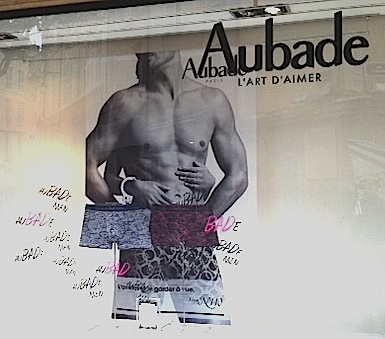

BAD Men have arrived in France.

The French lingerie brand Aubade, known for its sexy advertisements, is focusing on men these days. Taking a clue from the popular TV series Mad Men, they have launched an ad campaign for a line of men's underwear in the form of snug little shorts. Wear these and women won't be able to keep their hands off you, they claim.

Anyone out there wanna give it a try?


FINAL INSULT

I've had a perfectly wonderful evening. But this wasn't it . − Groucho Marx
;-)


Sunday, May 26, 2013

Merry Month of May, Unhappy French, English at French Universities, Hollande Press Conference


MERRY MONTH OF MAY

France has four national holidays in May: Labor Day (May 1), WW-II Victory Day (May 8), Ascension (May 9), and Pentecost Monday (May 20). It is an unproductive month, especially this year when May 8 and 9 fell in mid-week and severely hampered business the entire week when people took off the three remaining work days in order to get nine consecutive days off. "Faire le pont" ("making the bridge" from a holiday to the nearest weekend) is standard practice in France where employees have generous vacation time plus additional free days (RTT) in exchange for overtime. With a 35-hour work week, all those who work more hours get overtime paid out in the form of RTT, and it is these RTT days that are used to lengthen work breaks throughout the year.   

The national statistics institute INSEE estimates the cost of the reduced production in May 2013 at 0.1% of GNP or 2 billion euros, which raised the question: should we drop a holiday in May? In this time of economic crisis and budget deficits that may seem a good idea, but neither the government nor the main unions seem to be in favor. Union leaders defend the "important work-life balance that is essential for family life" and should outweigh economic gain. Labor Minister Michel Sapin says: "Take back a holiday in May? Let's be reasonable. These days off will allow people to work even harder afterwards." This same minister also turned down the request of certain businesses to stay open on Sunday, such as home improvement, furniture stores and garden centers/nurseries. As he explained on a popular radio program: "This would mean that bit by bit the Sunday rest of French employees would be sacrificed. I will not allow it."

Sapin is clearly taking his clue from President Hollande who, in looking for ways to cut the deficit, has so far carefully avoided the subject of leisure time. It is a complicated issue and not worth a fight at a time when he needs backing on more pressing issues (retirement, school reform). Besides, the same INSEE study indicates that the loss of productivity in May is partly offset by an increase in revenues from the transportation and hospitality industries. A few years ago, then-president Sarkozy's call to "work more to earn more" fell on deaf ears, and today the French still choose time off over increased earnings.

Surprisingly, with 11 national holidays per year France is far from the leader in Europe, where Cyprus tops the list with 15 holidays a year (followed by Greece), while Holland and Great Britain close the ranks with only 8 holidays a year. Some business leaders suggest that the problem in France is not so much the number of holidays, but the concentration of them in May.


THE UNHAPPY FRENCH

Claudia Senik
More vacation time does not seem to make the French happier, however. In a recent television interview on France 24, Professor Claudia Senik of the Paris School of Economics called the French the most pessimistic people in the world. In a study she presented at the Royal Economic Society in London last month she claims that the French are unhappier than other nationalities. "I think the French school system is partly to blame", she says. "With its grading system on a scale of 0 to 10 it is very difficult to get high grades, so students quickly get a negative view of themselves. It is well known that American children have a much more positive view of themselves, where school is geared to build self confidence". Senik thinks French schools are too strict and need changing. She also claims that, regardless of favorable external circumstances (generous social benefits, long vacations, early retirement, etc.) the French have an innate mentality or culture that predisposes them to being negative.

"In life you always compare your position in reference to some benchmark, and in France that is the grandeur of the old francophone empire and the influence France used to have in the world. That is gone for good and people have a hard time accepting the decline but they don't really appreciate the new world either. They dislike market-based globalization, and they should learn more foreign languages if they want to fit into this globalized new world. If they learned to speak English and got a closer look at the rest of the world, they would be happier", she concludes. 


My take? The French are habitual complainers, quick to take to the streets to demonstrate against one thing or another, and with a deep-seated fear of change. Their children grow up seeing and hearing this constant griping in the home and in the street and are affected by it. Like their parents, they soon come to see the glass as half empty, and the wider world as a threat against French superiority. [Click here for the chapter RALEURS in my book TAKING ROOT IN PROVENCE and a closer look at the French reflex to resist change.]


ENGLISH IN FRENCH UNIVERSITIES? QUELLE HORREUR! 

This fear of change was evident again in the recent outcry against the government's proposal to allow certain courses at French universities to be taught in English, a subject that is still being hotly debated on television and in the press.

In order to attract more foreign students to France, Minister of Higher Education and Research Geneviève Fioraso, introduced a Bill in the General Assembly whose Article 2 would allow more subjects to be taught in English at French universities. The bill was finally adopted by the Parliament on May 23rd, following a long and stormy debate and only after an Amendment was added that required foreign students to pass a French test at the end of their studies before receiving their diplomas. Objections ranged from "It is an attack on the French language" to "Dangerous encroachment of Anglo-Saxon influence on our society" and "It will mean the slow death of the French language". One outraged Socialist deputy even called it "la pire des humiliations pour les francophones".


Geneviève Fioraso
It is generally acknowledged that today international business is conducted in English, and that compared to other nationalities the French have a poor command of English and therefore do less well in finding jobs abroad. Yet, they see the advent of English in their universities as a displacement of French rather than an opening of doors to a wider world and its opportunities. Even French intellectual and former presidential advisor Jacques Attali as well as bookish journalist Bernard Pivot argued against the introduction of English, and the Académie Française thinks it would undermine the position of French in higher education.

Minister Fioraso responded that only one percent of all courses would be taught in English, mostly in science and business, and that research labs have been working in English for years. Moreover, a second language has never killed a first one. "We need to adapt to the real world. Chinese, Indian and South Korean students flock to British and American universities, rather than come to French ones, because of the language. Courses taught in English would increase the number of foreign students here, who in turn would absorb the French language and culture and spread it in their home countries." 

The French press varied widely in its opinion on the subject, with the extreme right and extreme left violently opposed to English and others being more nuanced in their positions, but one thing they shared was passion. Hardly ever has a subject roused such impassioned debate as the venerated French language. It was not a political issue (even among the Socialist majority 40 deputies voted against), nor one of age (young and old similarly divided), but one of a shared, inculcated passion for a precious possession: the French language.

French daily Le Monde, in tones less strident than its colleagues, defended the bill, stressing that the language of international exchange is English and that there are no borders to information and knowledge. Catholic newspaper La Croix was against, prominently quoting deputy Benoist Apparu: "A people that speaks more and more of a foreign language looses its identity bit by bit". And, of course, several teachers' unions have called for a strike before the final vote.

Curiously, no mention anywhere of the heavy infiltration of English words into the French language with results like relooker, benchmarker, booker, fooding, footing, manger avec feeling and worse, or words like cool, pressing, and people that take on surprising new meaning in France. All French universities offer Master's degrees (formerly Maîtrise), and courses in Engineering or in Management (formerly Gestion), while a course on Knowledge Management is listed as "Management des Connaissances". Where was the Académie Française when all this was happening?


HOLLANDE'S PRESS CONFERENCE

On May 16th, President Hollande held a press conference in the Elysée Palace attended by 400 French and foreign journalists. It lasted two and a half hours but contained little if anything new. Aware of his low approval rating and of being called "indecisive" he took a more forceful tone than during his first press conference six months ago, and repeatedly spoke of his "offensive" to bring Europe out of its lethargy and of his support for a single European economic government under one "true" president. Somewhat self-congratulatory in his evaluation of his first year in office, Hollande refused to be pinned down by aggressive journalists, showed good humor throughout the exchange, but offered no new ideas or concrete measures, maintaining his earlier positions and claiming that time will prove him right. In the face of France's current recession and increasing unemployment, the message received was long on déjà vu and short on hope.


WITTY WOODY

 "I once took a speed-reading course and read War and Peace in 30 minutes. It is about Russia." (Woody Allen)   


Wednesday, May 8, 2013

NETHERLANDS, MARSEILLES, ITALY, INSULT


HOLLAND HAS A KING!

On April 30th Dutch Queen Beatrix abdicated in favor of her son Willem-Alexander who at age 46 became the youngest reigning monarch in Europe and the first king Holland has known in 123 years. After she signed the formal abdication act the 75-year-old queen, now Princess Beatrix, stepped out onto the balcony of the Royal Palace in Amsterdam with the future king and queen, Willem-Alexander and Maxima, to say farewell to a huge and cheering orange-clad crowd gathered on the Dam Square below. Beatrix was a popular queen during her 33-year reign, but the people seemed quite happy to see a younger generation take over, especially when Willem-Alexander announced that he wants to "modernize" the role and be a less formal monarch for the 21st century.


Queen Beatrix passes the scepter


During his student days, Willem-Alexander was known as a hard-partying, beer-guzzling frat boy who acquired the nickname "Prins Pils" (lager). The nickname stuck and it took years for the party-boy image to make way for that of a more mature, well rounded person with the requisite qualities of a future king, no doubt helped along by marriage and fatherhood.

It has to be said that one of Willem-Alexander's biggest assets is his Argentine-born wife Maxima who has turned the down-to-earth Dutch into adoring fans. More than her beauty and intelligence, it is her spontaneity and ready smile that worked magic and broke down the initial resistance to "the daughter of a junta-tainted former Argentine minister" who might one day become queen.

Willem-Alexander, Maxima and children

Now that that day has come and people in Holland have taken Maxima to their hearts, they are proud and happy to have her as their glamorous new queen, and all seem convinced that it is a tremendous benefit to laid-back king Willem-Alexander to have the clever and beloved Maxima by his side, even though their role is largely ceremonial and the new king has very limited powers. But the unifying role of the royals should not be underestimated in this small country of nearly 17 million people of many ethnicities and at least ten political parties. In times of crisis or political upheaval, the monarchy has more than once proved to be a stabilizing factor.


King Willem-Alexander, Queen Maxima

I was in Amsterdam during their wedding in February 2002 and even then passions seemed to run high for Maxima − mostly in favor, but with a vocal group of dissenters. A few smoke bombs were set off along the wedding route and some paint was thrown at the Golden Coach carrying the young couple. Similar incidents had marred the wedding of Queen Beatrix and German-born Prince Claus in 1966, with protesters denouncing his war-time record of young Nazi officer. [In his youth Claus had briefly been a member of the Hitler Youth and of the Wehrmacht. He was 19 years old when the war ended.] He did, however, win the trust and backing of the Dutch people and as prince consort became a much-loved figure in Holland.
L'histoire se répète...   

As in 2002, there exists today an element of anti-royalists in The Netherlands, but a recent IPSOS poll showed that 78% of the Dutch are pro-monarchy − an impressive figure when one considers that some 20% of the country's citizens are not Dutch born.

One Dutch subject, who professes to be neither pro- nor anti-monarchy, is my Argentine-born husband Oscar. Opting for a Dutch passport once we settled in Europe, he has since acquired an Argentine queen and an Argentine pope. Can't run away? I prefer to think that he is in good company. 


MARSEILLES


From the joyful atmosphere in Holland we move South to another happy event: this time in Marseilles. On the evenings of May 3 and 4, the Vieux Port of Marseilles was transformed into a magical world of flame-lit wonder. No expense was spared in the creation of this MP13 celebration that involved 12,000 fire pots installed along the Vieux Port and on a specially constructed footbridge that allowed visitors to walk across the water from one bank to the other.

Large metal frames in various shapes and sizes supported the fire pots (flower pots filled with wax) that stood, hung or floated everywhere and were lit by 60 official lighters who, equipped with long lighting poles, set fire to the pots at 8:30 PM and kept vigil until the fires were burnt out three hours later. 


Unlit fire pots
Floating fire pots


Vieux Port entre Flammes et Flots


The "Vieux Port Entre Flammes et Flots" festival drew 400,000 visitors who spread across the main Esplanade (with Norman Foster's popular "Ombrière") and the closed-to-traffic boulevards flanking the port like a slowly moving human carpet. The 160-meter-long pontoon bridge, designed to carry 4000 people at a time, was particularly appreciated and soon had waiting lines of over an hour. But nobody seemed to mind and those who made it across called it well worth the wait.

The bars and restaurants lining the Vieux Port were packed and we finally got an outside table at a place where we found out too late that they served no alcohol and that the specialty of the house was "chicha" smoked through a narghile pipe. Many young couples around us were ordering chicha, putting to bed my notion that the water pipe was mostly for older men in the Middle East. Too happy with our table, we wouldn't think of leaving and stuck to fruit juices as we enjoyed the gay and festive mood all around us -- and marveled at the fact that this huge and ethnically diverse crowd peacefully and happily partied together, without incident, as had been the case in Amsterdam a few days earlier.


ITALY

Enrico Letta
Italy finally broke the political deadlock, but no one is cheering.
Within days of Italian President Giorgio Napolitano's re-election on April 20th, the fractious Italian parties managed to agree on a candidate for Prime Minister:  Enrico Letta, 46, who was vice-president of the center-left Democratic Party (PD). He quickly formed a compromise government from the left and the right, and won a vote of confidence after pledging to focus on growth.

Significantly, he named as Deputy Prime Minister and Minister of the Interior Angelino Alfano, former Justice Minister and main "fixer" for Silvio Berlusconi, said to be the architect of laws to benefit Berlusconi in his legal battles. It should also be noted that Enrico Letta's uncle is center-right politician Gianni Letta, a long-time advisor to Mr. Berlusconi.
And the winner is...


Further evidence of Berlusconi's influence can be found in the fact that Enrico Letta's first act was to scrap the IMU housing tax instituted by Mario Monti, which Berlusconi had vowed to nullify.

Score one for Berlusconi − and a loss to the government of 8 billion euros a year.


GLORIOUS INSULTS

After Berlusconi, do we really want another insult?  Oh, let's...

A member of Parliament to Disraeli: 
"Sir, you will either die on the gallows or of some unspeakable disease".
"That depends, Sir", said Disraeli, "whether I embrace your policies or your mistress".