Saturday, March 31, 2012

DSK, CURTIS ROOSEVELT, HAPPY EASTER

DOMINIQUE STRAUSS-KAHN  -  AGAIN

Dominique Strauss-Kahn cannot seem to stay out of the news. For the past few days radio, television and newspapers have covered - ad nauseam - his latest troubles with the law which, in fact, are not new but simply the progression of his legal cases in France and the United States, i.e. his involvement in the "Carlton Affair" in Lille and the civil lawsuit in New York filed by hotel maid Nafissatou Diallo for an alleged rape attempt.

After a hearing in Lille on March 26th - two days earlier than previously announced to avoid the media circus that had made the first hearing so difficult - DSK now stands charged with "aggravated pimping" which carries a potential sentence of 20 years in prison. During this second hearing DSK admitted to attending "libertine parties" but still maintained that he did not know that the participating women were paid prostitutes. The investigating judges seem to have rejected that argument, based on a number of text messages between DSK and those who supplied the girls. After posting 100,000 euros bail, DSK was free to go until further notice.

Meanwhile, in New York City the civil suit against him was certainly aggravated by the French charges and DSK's lawyers have announced they will plead diplomatic immunity as their defense. A large amount of money will probably settle this case which, nevertheless, may take up to two years before it's concluded.

After the shock of the perp walk and Ryker's Island last year, which the French witnessed with horror and denunciations of the savagery and brutality of the American judicial system, today the mood in France has turned against DSK. This time there seems to be a merciless attempt to do irreparable damage. The usual scenario - he did wrong, he'll pay the price, end of story - does not apply here as it did for Bill Clinton, Elliott Spitzer and numerous others. Puritan America is less quick to forgive sexual misconduct than France or Italy where this may draw a slap on the wrist and a wink from the judge ("Don't do this again, you lucky bastard"). Remember that the French press knew of President Mittérand's mistress and illegitimate daughter, but out of respect for the man and his position never breathed a word of it until after his death. All the more surprising then that the respected French newspaper Le Monde - a real opinion maker and as far from the gutter press as you can get - has just leaked the transcript of DSK's first hearing in Lille, including the denigrating terms he used to describe women. It seems sensationalist and unnecessary - the man is down and out, and kicking him now borders on the bloodthirsty. Wherever he is headed - to prison, surely to banishment for life from the French political scene where as little as a year ago he seemed poised to become the next French president - this broken man should be allowed to disappear quietly and walk the path to his personal hell without the vengeful clamor in the media today.   

CURTIS ROOSEVELT

Curtis Roosevelt, 82-year old grandson of Franklin and Eleanor, lives in a hamlet in southern France where he settled 13 years ago. This tiny village may be sleepy but Curtis is not. He writes chronicles for the Huffington Post and has now joined a collective named Roosevelt 2012 together with other old agitators like 94-year old Stéphane Hessel (known for his phenominally successful pamphlet-length book Time for Outrage, published at age 92), 90-year old French philosopher and sociologist Edgar Morin, and 81-year old Michel Rocard, member of the European Parliament and former socialist Prime Minister of France.    

Curtis Roosevelt


Their objective is to "snap at the heels" of the candidates in the current French presidential race, to raise their awareness of the similarities of today's problems with those of the Great Depression of 1933, and to urge immediate action. They want socialist candidate François Hollande to beat incumbent Nicolas Sarkozy, but only if he commits to fulfilling within the first three months of his presidency the 15 conditions they outlined in a little booklet that came out on March 28, 2012 entitled C'est plus grave que ce qu'on vous dit... Mais on peut s'en sortir ("It's worse than you've been told, but we can beat it"). Written by Roosevelt 2012 member Pierre Larrouturou, the economist of the group, it pleads for a re-start of the economy by means of certain fiscal measures that were used successfully by Franklin D. Roosevelt in his New Deal.

When not engaged in politics, Curtis Roosevelt has been involved in the preparation of the French edition of his autobiography "Too Close to the Sun" which is scheduled to appear in September 2012.

In his quiet corner between Nîmes and Avignon, he enjoys buying fresh products at the village market where everyone calls him "Curtis" and where - in spite of his poor French - the local people have come to understand and enjoy this kind American who orders his fish "saignant" and who professes a great appreciation for "la table et le fun." "Like my grandfather Franklin," he says.

HAPPY EASTER!

This time I'm really off and away for a month. But before leaving I'll share with you an unusual Easter card I received from an Italian friend. With all due apologies to those who believed Easter eggs came from the bells of Rome, I wish you all a Happy Easter.


See you again in May.


Monday, March 19, 2012

Correction, Driver's License Trouble, More Bombs in Marseilles, François Hollande

CORRECTION

In the Vacation Bound item of my last posting, I mentioned that in spite of the financial crisis 53% of all French people have plans to take at least a one-week vacation away from home this year. That should have been 67% - fully two-thirds - of all French, as confirmed by Protourisme at the recent Salon Mondial du Tourisme in Paris. The same source announced that nearly 80 million foreign tourists are expected to visit France in 2012, over 3% more than in 2010.


DRIVER'S LICENSE TROUBLE (*)

In Lyons the driving inspectors have decided to strike for a wage increase after negotiations with the government broke down. This is expected to delay between 1000 and 2000 driving tests, a nuisance we have experienced ourselves a number of years ago when inspectors in Aix-en-Provence struck in protest against aggressions by students they had failed. At that time, test results were given right away but today they are announced by mail. Driving tests are more difficult here than in the United States and many applicants fail at least once or twice. Depending on the time of year, getting a new test lined up can take months so an inspectors' strike is a big deal. One consolation is that you'll go through this misery only once since a French driver's license is issued for life!


MORE BOMBS IN MARSEILLES

Bomb with embedded jackhammer

After a major bomb scare in January which required 4300 people to be evacuated, another bomb was found in Marseilles when a heavy road drill accidentally pierced a World War II bomb, this time of German origin, and partially set it off. Miraculously, the explosion caused only two minor injuries but removing the damaged bomb with its 650 kilos of explosives and the drill head still inside posed a challenge. About 1500 people were evacuated during the removal operation in the Joliette neighborhood where the bomb was found. Luckily, Joliette consists mostly of office buildings including the impressive new headquarters of shipping giant CMA-CGM, a 142-meter glass tower designed by world-famous architect Zaha Hadid. Had the full charge of the bomb exploded, experts say, it would have flattened two city blocks.  

Hadid-designed headquarters

The port of Marseilles was heavily bombed during World War II, and with more construction work going on around the port area in preparation of next year's 2013 Cultural Capital of Europe celebrations, there is some fear that this may not be the last bomb to be discovered. On the other hand, since the end of the second world war much construction has taken place in France's second-largest city, including a metro in 1977, without a single bomb scare.  


HOLLANDE DRAWS PEOPLE

During this presidential election campaign a newspaper headline: "François Hollande s'entoure de people" seems unremarkable enough. But those among you who do not speak Franglais might have concluded that François Hollande attracted people, which is the least one might expect from a presidential candidate. Things become more interesting when you know that "people" in France has acquired the specific meaning of "famous people," or "stars." Pronounced peepull (rhymes with dull) and sometimes spelled "pipole" in the French press, this new word has the peculiarity of always being used in the singular, as in "un people" for "a famous person" or "la presse people" for tabloid press or gossipy magazines with lots of pictures, like our People magazine. In Hollande's case, the term referred to some of the well-known people who appeared at his side during the recent Salon du Livre in Paris, such as Alexis Jenni, recent winner of the Prix Goncourt (equivalent of our National Book Award), Stéphane Hessel, and Jeanne Moreau. It was an occasion for Hollande to announce that, if elected, he would reduce the value-added tax on books from 7% to 5.5% and regulate the leases on inner-city bookstores to allow them to stay in town.   


(*)  Check out Taking Root in Provence for driving license requirements in France and for the joys of Franglais; click here.


Friday, March 16, 2012

Ethylotest, Getting Nasty, Exception Marseillaise, Vacation Bound


ETHYLOTEST

The French government has announced that from July 1, 2012 on, every automobile in France must be equipped with an Ethylotest, a device that measures the alcohol content in the blood of the driver. Motorcycle drivers too will have to have this breathalizer bag on board. Those caught driving without it will be fined 11 Euros. Bars and night clubs serving alcohol have been obliged to carry breathalizers of one sort or another since last November, but this rule has now been extended to all drivers. In France, 31% of all fatal accidents are alcohol related, and Nicolas Sarkozy is counting on the breathalizer to help him reach his target of 3000 road fatalities this year − down from nearly 4000 in 2011. For good measure, he is adding 400 fixed radars to the existing 2500 along French roads this year.


GETTING NASTY

Nerves are beginning to fray as the French presidential campaign enters the final stretch before the election on April 22 and May 6 (runoff). In one of his televised interviews incumbent Nicolas Sarkozy called his main rival, Socialist François Hollande, a liar: "He lies from morning to night" he said − rather unusual in France where political pronouncements and stump speeches may be brutally attacked but not a candidate's character. Ever since his election in 2007, when he celebrated his victory at a fancy Paris restaurant with rich friends, followed by a vacation on a wealthy friend's yacht, Sarkozy has been perceived as a "president of the rich." Despite some awkward apologies for poor judgment and a back-breaking schedule of "meet-the-people" campaign stops, he has not been able to shake this image and the wear and tear shows when he tells a hackler to "get lost" and gets visibly irritated during TV interviews.

Sarkozy and Hollande

The three main contenders − Sarkozy (centre-right), François Hollande (left) and Marie Le Pen (extreme right) − have been slugging it out in the public arena but so far without facing each other. After weeks of trailing Hollande in the polls, Sarkozy has begun to move increasingly to the right and is making a shameless play for the constituency of Marie Le Pen. "We have too many foreigners in France" and "I want to cut immigration in half" are his new themes, as well as the promise of a Made-in-France or at least Made-in-Europe policy like president Obama's Buy American Act to keep French factories running. It did boost his score and the latest polls now put him slightly ahead of Hollande. Both camps are on high alert and this race promises to be tight until the very end.


EXCEPTION MARSEILLAISE

There has been much talk lately about the unusual work contract of the municipal garbage men in Marseilles. This contract calls for 7 hours work per day for 5 days a week with the specificity that those who can get their work done faster can leave as soon as the job is done (and, often, go on to another job). Result: the garbage collectors of Marseilles manage to do their rounds so fast that they work an average of 3.5 hours a day for 7 hours of pay. This is locally referred to as "Fini-Parti" (loosely translated as "Done-Gone") and is perfectly legal. Problem is that the flying cleaning squad does not seem to do a very thorough job of it and that Marseilles is today the dirtiest city in France and, according to local journalist and author Hugues Serraf, pays the highest cost per inhabitant for garbage collection. It also has a history of frequent strikes and strong-arm tactics in wage negotiations. We remember 2007 when Marseilles was one of the four candidates proposed by Switzerland, winner of the previous Cup, to host the America's Cup sailing competition. A well-timed week-long garbage strike in mid summer offered the Swiss selection committee a smelly and unsightly welcome that quickly led to the choice of Valencia as host city.


Garbage strike in Marseilles

So far, no mayor has dared go against the garbage workers' strong union (Force Ouvrière), and when a courageous citizen recently filed a petition in court for a "return to normal" he lost against the legal argument that the "fini-parti" is normal since it is a "historic custom that cannot be abrogated" (even though the judge promised to make a final ruling at a later date). The popular Marseilles-based TV series "Plus Belle La Vie" has already been renamed "Poubelle La Ville" by some. One fears for 2013 when Marseilles will be the Cultural Capital of Europe.

A citizens' group has now created a blog with a plea to end the "fini-parti" and it is producing results. A new gadget will soon be introduced that is able to track the working hours and the movement of each Dumpster in town. Called a chronotachygraphe, this device is expected to demonstrate the failings of the "fini-parti" rule and finally have it eliminated. The mayor has already consented to hiring 40 additional street sweepers a year for the next 2-3 years and requires garbage collectors to pick up around the Dumpsters from now on. There is hope for 2013.


VACATION BOUND

The financial crisis of the past few years is not stopping the French from taking vacations. A recent poll by Protourisme revealed that 53% of the French plan to take at least a one-week vacation away from home this year, up by 1% from last year, and to spend more on their next vacation, i.e. at least 2300 Euros (approx. $3000) per family. This is the first increase in 10 years. With a minimum of 35 days of paid vacation per year, most French people have always taken a winter and a summer holiday, but in recent years they have traveled less far as a result of la crise.

Speaking of holidays, I will soon be leaving for a month-long family visit on different continents which will silence this blog for a while. I will miss Eastertime in Provence (*) which is celebrated with a Good Friday meal of Aioli (cod with boiled vegetables and a strong garlic mayonnaise) and Easter Sunday dinner of roasted lamb, as well as a four-day bullfighting Feria in Arles, folkloric feasts in villages, and the first big wave of travelers from the North.

Grand aioli de Provence

Have a Happy Easter wherever you are;  I look forward to talking to you again in May.


(*) To read about Easter in Taking Root in Provence, click here.


Sunday, February 26, 2012

Salon de l'Agriculture, Frozen Toilets, DSK/Sinclair

SALON DE L'AGRICULTURE (*)

Paris, 2/25 - 3/4.  It's that time again, and as always the lead story on all television news channels. For nine days every year, Paris hosts the biggest farm in the world when French farmers bring their best animals and products to the giant show grounds of the Porte de Versailles. No less than 4500 animals are exhibited here, from big bulls and draught horses to dairy cows, pigs, sheep, goats, fowl, ducks - the whole live food chain and the products they produce. Children can pet all the animals they can reach, while adults are drawn to the bigger beasts and to the food and wine or beer handed out everywhere. This Parisian event attracts 650,000-700,000 visitors every year and - inevitably - lots of politicians who come trolling for votes and for face time on TV. Farmers, who are traditionally of the right, still talk fondly about former president Jacques Chirac who was their greatest supporter and who never missed a Salon, where he happily patted or stroked the animals around him and ate and drank everything offered. President Sarkozy, who is running for re-election this year, is less at ease with animals and does not drink wine, but aware of his patriotic duty did pose with a handsome cow and tasted some cheese while saluting the admirable tradition of the French family farm. Vive la France!

Sarkozy at the Salon de l'Agriculture

FROZEN TOILETS

How cold was Aix-en-Provence last week? Cold enough for the girls' toilets at the new Arc-de-Meyran high school to be frozen! A half-page article in the local paper indignantly reported that this multi-million euro school that is less than two years old and counts 950 students was so poorly designed that the pipes to the 20-toilet unheated girls bathroom freeze below a certain temperature. Built on the shady side of the building and therefore cool year-round, this space is located close to the boys' bathroom where pipes do not seem to freeze. School management decided that for the time being, the girls will have to use the boys' bathroom. Problem is, to get to the boys' toilet stalls the girls have to pass a row of open urinals which both sides found too embarrassing, so a guard has been appointed to regulate the male-female use of the few functioning toilets and guarantee some privacy. 
Meanwhile, the Education Department has determined that the girls' toilet space was in conformity with prevailing construction standards and the new rules for sustainable development and energy savings. Only concession: before the beginning of the next school year in September, the broken pipes and water meter will be repaired. Until then, the nine toilets in the boys' area will have to do for 950 students. [Didn't I promise you "French news"?]  

DOMINIQUE STRAUSS-KAHN
The saga continues.

A few days ago, the Cambridge University Student Union voted against the invitation of DSK to come and speak about the "State of the Global Economy" at a conference on March 9th. "This invitation by the University gives him public legitimacy at a time when he is still being questioned by police" said Ruth Graham, spokeswoman for the women of the CUSU whose petition carried 355 signatures. A cold shower for DSK after his warmly applauded appearance at an international conference in Peking in December.

On February 22, after two days in police custody in the city of Lille where he was questioned about an alleged prostitution ring in connection with the Carlton Affair, Dominique Strauss-Kahn was released but ordered to appear again before investigating magistrates on March 28, when three judges will grill him about the soirées libertines - orgies in plain English - in which he is known to have participated. Prostitution is not against the law in France, but pimping or profiting from prostitution is. The services of the women made available for these parties were paid for by a businessman without apparent quid pro quo. Strauss-Kahn has already stated that he did not know that the women he was introduced to were prostitutes, to which his lawyer added: "At these parties people do not necessarily wear clothes. How do you distinguish a naked prostitute from any other naked woman?" Just so you know.

Meanwhile, in New York where this affair is being followed closely by alleged victim Nafissatou Diallo and her lawyers, the civil suit she filed against DSK is being heard on March 15 - the Ides of March!


Anne Sinclair, DSK's wife, is moving right along and has accepted to appear on French television in an upcoming emission of the literary program "La Grande Librairie" where she will discuss her new book 21 Rue la Boëtie, the address of her grandfather Paul Rosenberg's art gallery in Paris. Friend and promoter of some of the greatest 20th-century artists, including Picasso, Braque and Matisse, Rosenberg had to flee Vichy France in 1940 and moved his gallery and family to New York, where his granddaughter Anne Sinclair was born. "This is my grandfather's story," said Sinclair "and indirectly mine."


(*)  To see a chapter on the Salon de l'Agriculture featured in Taking Root in Provence, click here.

Thursday, February 16, 2012

Aftermath, Ice Problems, DSK

AFTERMATH


The recent fire at Le Corbusier's Cité Radieuse in Marseille has had an unexpected fallout. In the end, eight apartments and four hotel rooms were completely destroyed, and some 40 hotel rooms were damaged. The extent of the overall damage is such that the organizing committee of Marseille 2013 (Cultural Capital of Europe) have made a preliminary decision to withdraw from the 2013 cultural events agenda the Cité Radieuse where several exhibits had been planned as well as visits to the model apartment with its famous integrated furniture designed by Charlotte Perriand in 1952.


TOO MUCH ICE AND NOT ENOUGH ICE

Last Saturday 2/11 a rugby match between France and Ireland at the huge Stade de France outside Paris was canceled literally one minute before the starting time of 8 PM, leaving 80,000 shivering spectators furious and uncomprehending. After much hesitation, the British arbiter made the decisive call and declared that the frozen field was too hard and dangerous to play on, despite desperate efforts to soften the surface with the help of huge hot-air blowers.

Hot air at rugby match


That same day in Holland, the long-awaited Elfstedentocht was finally called off because at some spots along the 125-mile track that links 11 cities in Friesland the ice had not frozen to the minimum thickness of six inches required for this historic speed-skating race.

Disappointment all around.


DSK ON FILM

For DSK followers, this titillating tidbit in the French newspaper Libération which reported that a porno video has just come out called DXK. The action takes place in a hotel suite where a rich and powerful guest seduces a poor hotel maid. Just to make sure you won't confuse this situation with a recent case in New York City, DXK is called David Sex King and the hotel suite number has been changed. You weren't thinking of the other guy, were you?


Meanwhile, newspaper Le Monde announced that American filmmaker Abel Ferrara has been working on a film about The Affaire DSK, with actor Gerard Depardieu playing Dominique Strauss-Kahn and Isabelle Adjani his wife Anne Sinclair. The film deals with sex and politics (surprise!), according to Ferrara, and will be filmed in Paris, Washington DC and New York City. To be released before the summer of 2012.


Depardieu:  "What - me DSK?"
  

Friday, February 10, 2012

Blast of Winter, Le Corbusier, Politics

WINTER -- FINALLY!

After an extremely mild early winter, in late-January we suddenly got a blast of cold air from Siberia that turned most of Europe - including southern France and Italy - into a snow and ice-covered winter landscape that quickly turned deadly. It is rare that we have sub-zero temperatures here for brief spells, but this time they not only lasted some two weeks but they dipped way below zero in a number of Mediterranean countries (minus 8 Celsius or about 18 F in Aix-en-Provence) where this is not supposed to happen. So far 540 people have died as a direct result of the cold, most of them in Eastern Europe, but many of them in Italy as well. In France, the power network is stretched to the limit and people have been asked to watch their consumption of electricity for fear of blackouts.


Aix fountain
Life in the city is quieter:  less traffic, fewer people in the streets and fewer stalls at the market. Fountains in Aix have stopped spouting or dripping and have frozen into icy sculptures and stalactites. Snow removal and salting equipment is used on the main roads only, and some of the remoter villages are now accessible only by 4-wheel-drive vehicles and have not seen public transportation for a while.


Aix fountain

In Holland, however, excitement is growing to fever pitch over this sustained deep-freeze in hopes that it will finally allow the famous Elfstedentocht (eleven-city tour) to be run again after 15 years of mild winters. This grueling 125-mile speed-skating race on frozen canals and waterways links eleven cities in the northern province of Friesland and requires thick ice all along the way to support the 16,000 registered competitors. 


Elfstedentocht in Friesland


Two million spectators are expected to turn out for this near-mythical race in a country where ice-skating is second only in popularity to soccer. The race was tentatively planned for the weekend of 11-12 February but when the organizing committee pronounced on February 8th that along the track some patches of ice had not frozen to the required minimum of 6 inches and that the race may have to be cancelled, it brought the fans close to tears.   


Dutch soldiers sweeping snow

Fifty soldiers were dispatched onto the ice to sweep the snow (which warms the ice) and hundreds of volunteers took off from work to do the same. It's a race against time (temperatures are said to begin rising next week), but no one is wiling to give up just yet. The on-again off-again suspense continues, but in the meantime, the canals in Amsterdam have turned into a Pieter Brueghel painting of skaters, big and small, who may one day be good enough to run the Elfstedentocht.
    

Amsterdam canal scene


LE CORBUSIER


In the night of 9 February a virulent fire broke out in the famous Cité Radieuse in Marseilles - Le Corbusier's 7-story housing block consisting of 334 apartments that was designated as a historical monument in 1986 by the French Ministry of Culture. All 1500 occupants were evacuated, seven apartments were destroyed by fire and many others sustained smoke or water damage. This project built by Le Corbusier and opened in 1952 was his first Unité d'Habitation designed along his "ideal measurements" for communal living (double-height spacious apartments of similar floor plans, all with brightly-painted balconies). It also contains a nursery school and playground, roof-top swimming pool and running track, a hotel, cinema, restaurant and internal shopping avenues - hence the self-contained "radiant city" of its name. The cause of the fire has not yet been determined.

La Cité Radieuse, Marseilles


Rooftop with pool


POLITICS

Much of the recent news coverage in Europe has been centered on the weather which displaced the latest Greek loan negotiations in Brussels, the continuing euro-saga, and the incessant French voter polls. There even seems to be less of the usual sniping between the French right and left, and you could almost forget that this is an election year in France. Can't say we miss it, but if we did we could always switch to CNN for the Republican pre-election debates which, to say the least, I find rather scary. Fortunately, we have just discovered the HBO series The Sopranos at the Aix public library and are getting hooked - like millions of Americans before us - to the doings of this mafia family. Somehow seems less scary than some of the political talk we are hearing.  


Thursday, January 19, 2012

Happy New Year, Kings' cake, DSK-Sinclair, French Juries, Lotteries, Truffle Wars, Marseilles, Calanques

HAPPY NEW YEAR -- Santé et Bonheur pour tous!!

So it's 2012 already. Ouch! The older I get the shorter the years seem to get.
With a new year that's barely begun, I'll dip into the end of last year for my first item: a strike. Yawn... You're right, but this one produced a surprising reaction from the government. The security personnel at airports nationwide decided to strike just before Christmas, which caused the cancellation of numerous flights and the delay of others. This is the busiest air-travel time within France when families gather for Christmas holidays, and the disturbance was keenly felt in those long lines that formed at airport counters. Yet, as so often before, I found the French extremely tolerant and few of them took their anger out on the strikers whose right to strike is sacrosanct even though their timing was not much appreciated. After a few days, the government sent in the gendarmes to take over the security checks and things returned to normal. Explained president Sarkozy on television: "It is unacceptable that strikers take the French people hostage at a time of holidays when families get together." Of course, I remember many strikes against cutbacks in education or in health care, or even among judges and lawyers who took to the streets against government encroachment on their independence -- all well justified and widely supported despite the discomfort they caused -- but never before had a president declared this "hostage taking" unacceptable. Then again, that was not during a family holiday and not just before a presidential election...

Airport security agents on strike


GOOD NEWS, SORT OF ...

The first newspapers of the year tend to be predictable in their listing of last year's accomplishments, although some of those are rather self-congratulatory. For instance "This year, fewer road fatalities than last New Year's Eve!" loses a bit of its luster when you know that France has the worst record in Europe and that the slightly better figure of this year is mostly due to the increased number of gendarmes on the roads and the brand-new law that may hold bar owners co-responsible for drunk driving. All bars and night clubs that close after 2 a.m. are now equipped with alcohol-test devices for clients to use before they leave the bar and when this indicates a level beyond the legal limit for driving, the car keys are withheld and the client will be driven home by volunteers or by taxi. It has been proven to be effective, at least on New Year's Eve, but the cynics among us will wonder how soon this will go the way of most New Year's resolutions.  


LA FEVE

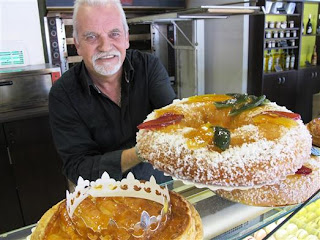
On Epiphany Day, January 6th, many countries, including France, celebrate the arrival of the three Magi with a traditional cake (called the Galette des Rois) that contains a fava bean (fève in French). The person who gets the bean will be king or queen for the day. This tradition is alive and well but in France the fava bean has been replaced by a porcelain token, still called a fève but no longer a bean, that can take the shape of the baby Jesus from the nativity scene, or a small santon, or a little fantaisie such as a mini delivery van with the name of the bakery painted on it. Over time, certain bakeries have distinguished themselves with their original tokens, but this year two bakeries made the newspapers. In the village of Vedène in the Vaucluse, a patissier introduced the "Galette Coquine" which contains one of a dozen different positions of the Kama Sutra. He also announced that once a week one of his galettes coquines will contain a little penis of pure gold! Collectors - get in line.

Fèves:  Naughty...
... and Nice

Meanwhile, in Aix-en-Provence, baker Serge Richier announced that he baked 1500 traditional galettes des Rois of which only one contained a real treasure:  a genuine English gold sovereign valued at more than 300 euros! The 1500 galettes were sold out in three days, which led the baker to announce that he would repeat his offer for St. Valentine's Day -- this time with a necklace of similar value, to be reclaimed by the person who presents the fève created especially for this occasion.   


STRAUSS-KAHN Saga - cont'd: 

Anne Sinclair, wife of you-know-who, has been appointed head of the new Paris bureau of The Huffington Post, renowned international blog. Well-known in her own right as a television journalist in France before the g(l)ory days of DSK, this new post should give her something to do other than standing by her man. And did you know that Sinclair was voted "Woman of the Year 2011" by French feminist website Terrafemina? Chosen for her "courage and tenacity" she inched past Christine Lagarde, current head of the IMF who replaced Dominique Strauss-Kahn. Hillary Clinton took third place. Speaking of DSK, he is slowly re-emerging in the socio-political circles in Paris where he used to shine. Just yesterday, January 11th, he and his wife were seen attending the screening in a movie house on the Champs Elysées of the about-to-be-released French television series "The Men behind the Scenes" and it looked just like the old days:  the famous couple, all smiles, were allowed to take their well-placed seats before the others and were quickly surrounded by old friends, PR people, and certain politicians who had cautiously kept their mouth shut during the scandal. And in mid-December DSK had been invited to an economic forum organized by "NetEase" in Peking where his 35-minute speech and subsequent interview were widely covered by international television. His pessimism about "Europe" drew a lot of attention here as well as his comment that "Nicolas Sarkozy and Angela Merkel are not on the same page" which creates grave problems in the eurozone. Is DSK getting back into the public arena? Let's say that for now he is back from the brink, at least.


JURY TRIALS IN FRANCE

As of this month France will be testing a new jury system, initially only in the cities of Toulouse and Dijon, in order to increase lay participation in criminal trials. Two jurors will assist three magistrates in cases punishable by five to ten years in prison (sexual assault etc.) in correctional courts. Heretofore, the French jury system was limited to cases before the Cours d'Assises (higher courts that deal with serious crimes such as murder) where nine jurors assist three investigating judges. If the test results are favorable, the new jury system will become applicable throughout the country as of 2014.


FRIDAY, JANUARY 13th

Superstition persists on Friday the thirteenth and in most countries with a national lottery system people will buy more tickets on a Friday the thirteenth than any other day. This is certainly true in France, where lines will form today in front of the bureaux de Tabac (places where cigarettes are sold) where people buy these state lottery tickets. The radio announced this morning that the year 2012 will have three Fridays the thirteenth. Yoopee for the gamblers.

El Gordo winners


This reminds me of El Gordo (The Fat One) in Spain, named after the top prize in the Spanish state lottery. Tradition has it that everybody in Spain buys lottery tickets at Christmas time, for themselves and for gifts to friends or family, which makes this the richest lottery in the world. I once witnessed this lottery fervor from my hotel window in Madrid when I saw a queue of people stretching for more than a block across the street. In these harsh economic times I thought they were lining up at an unemployment office, but it turned out that this was one of the places where tickets for El Gordo were sold and that many people pay someone to stand in line for them. This was early December and many days yet to go before the drawing on December 22nd, but these long queues would be a daily sight until the closing. For Christmas 2011 El Gordo's pot grew to 2.5 billion euros ($3.29 billion) and the first prize of more than 700 million euros was won by the small town of El Grañén (pop. 2100) where 1800 people had pooled their resources to buy shares in the top prize. In one fell swoop each of the 1800 participants received 400,000 euros for their 20-euro tickets, a particularly happy outcome for this hard-hit town where several businesses had closed and unemployment was high. A more-than-merry Christmas for El Grañén! And for the State, which does not tax these winnings but retains 30% of the total sum spent on tickets -- at more than 1 billion euros, one of the biggest takes since El Gordo was launched in 1812.   


TRUFFLE WARS

Truffles have long been a delicacy for which people are willing to pay a high price (1000 euros per kilo), but it's no longer just gourmets who go after them but thieves as well. An increasing number of truffières (truffle farms) are being plagued by robbers who come with sniffing dogs to dig up truffles in the dead of night. In two of the most "fertile" truffle areas of the Drôme and the Vaucluse regions, truffle farmers are now being helped by gendarmes equipped with special silent four-wheel-drive vehicles and night-vision goggles who patrol the back roads for these poachers. A number of arrests have been made and the gendarmerie has promised to keep up this increased surveillance until the end of the truffle season in mid-March. Between the wild boars in the area and this new human plague, some of these farmers are getting itchy trigger fingers, and in December of 2010 a truffle thief was fatally shot by a farmer.


MARSEILLE, TOUJOURS MARSEILLE...  (*)
(yes, Marseille takes an 's' only in English)

In 2013 the city of Marseilles will be the Cultural Capital of Europe. An honor, but quite a challenge in view of the size and complexity of some of the planned projects that are yet to be completed this year. There will be new buildings, new tunnels, new infrastructures, new green spaces, and 400 planned cultural events over 365 days for the 2 million tourists expected. The largest single new building currently under construction is the MUCEM (Museum of Civilizations of Europe and the Mediterranean) that is rising very slowly on the edge of the Old Port of Marseilles and has just hit another snag. This time, an unexploded American World-War II bomb was found that caused all further excavation to be stopped. The 500-lb device packed with explosives was located in a densely populated area and surrounded by some of the greatest historical treasures of the city. Before removing the bomb, extensive precautions had to be taken in a perimeter of 800 meters, including the evacuation of 4,300 people and the home confinement of 10,000 others, closing two nursery schools, blocking roads and tunnels, and stopping all commerce including shipping (cruise ships to be diverted) for a duration of 6 hours. Finally, on January 18th all services were coordinated and the bomb squad could go to work. It successfully removed the bomb, took it out to sea and exploded it 30 km off-shore. When the all-clear sounded, the locals heaved a sigh of relief, including the architect who can now resume this big project that is to be delivered in January 2013. Let's hope he won't be hitting some Roman ruin in the meantime.


MUCEM in Marseilles

CALANQUES

The stretch of coastline between Marseilles and Cassis is blessed with calanques - crystal-clear inlets flanked by cliffs and sometimes with small sandy beaches. These calanques can only be accessed by sailboats or by steep hiking trails, which saves them from overcrowding like most Mediterranean beaches. A project has been introduced last year, soon to be voted on, to turn this precious stretch of coast into a National Park in order to guarantee its preservation. Environmentalists and a good part of the local population applaud the initiative, but as the vote approaches political cracks are appearing, opposing groups are forming, the fishermen of Marseilles want guarantees that their fishing rights won't be interfered with, one local community is threatening to withdraw, and non-negotiables are being negotiated. And so it goes...

Calanque d'En-Vau


(*)  To read a special chapter on Marseilles in Taking Root in Provence, click here.