Saturday, July 28, 2012

BASTILLE DAY, TOUR DE FRANCE, CHURCH HOLIDAY, FIRES, BLACK CAT, GUNS AND CHEESES


BASTILLE DAY

France celebrates its national holiday - Bastille Day - on the 14th of July. On this day in 1789 an enraged mob attacked the Bastille prison, symbol of royal power, killed its warden and, with the consent of the newly established National Assembly, burned it to the ground. The French Revolution had begun. 

Bastille Day Parade

Today, the event is celebrated with a huge military parade as some four thousand members of all branches of the armed and civilian forces march down the Champs Elysées, with hundreds of mounted cavalry, vehicles, flyover planes and helicopters, jumping parachutists and marching bands as part of the show. And an impressive show it is as it unfurls for several hours down the most beautiful avenue in the world before an admiring crowd of thousands of spectators. Here is the France that they feel proud of, the France of La Gloire, the France that helps them forget the shameful sell-out of General Pétain to Nazi Germany. These are the victorious forces of General de Gaulle, of Bir Hakeim, of battles engraved forever in the Arc de Triomphe. It is a proud moment, this Défilé Militaire which opens a long day of festivities that end with spectacular fireworks at the Eiffel Tower which this year rocked to disco music. 


TOUR DE FRANCE

Another July event is the Tour de France, a three-week-long grueling cycling race through flat and mountainous stages that include fearsome Alpine and Pyrenean passes, two individual races against the clock, and weather that can go from mountain snow to valley heat in the space of several hours. This year the Grande Boucle was nearly 3500 km long, starting in Liège, Belgium, and ending in Paris.

La Grande Boucle


The 2012 Tour was won by Bradley Wiggins who wore the leader's yellow jersey for most of the Tour. His team mate and fellow Brit Chris Froome came in second, which made this a solid victory for the Sky Team and a first ever for Great Britain.

Accidents do happen and are sometimes caused by spectators who get too close or a dog that runs into the cyclers' path. It's stupid and irresponsible and, given the millions of roadside spectators, almost unavoidable. But when someone throws carpet tacks onto the road, as happened this year in the foothills of the Pyrenees, it is clearly malicious and meant to cause havoc. Fortunately, no serious injuries resulted here.
Tour winner Bradley Wiggins


Doping scandals have long plagued the Tour de France, and this year again saw two riders (out of 198) expelled for positive drug test results. Seven-time Tour winner Lance Armstrong was disqualified from participating this year because of unresolved doping issues in the United States.

The Tour de France has a fervent kind of following that cuts across age groups and social classes, and many a French fan can cite past Tour records and winners the way Americans can spout baseball statistics. Live television coverage attracts millions of viewers worldwide, and numerous businesses (banks, insurance groups, telecom, mining, sportswear, broadcasting, the French lottery, etc.) sponsor the competing teams, while "official suppliers" eagerly hawk their products all along the route. It's a BIG business. That background hum you're hearing is not just the whine of fast-spinning wheels but the singing of cash registers as well.


CHURCH HOLIDAY


This sign on a church door in Aix-en-Provence stopped me in my tracks. It reads: "The Church of St. John the Baptist will be closing for the summer. Last Sunday service on 21 July. Next service on Sunday, 12 September." I knew the French have long holidays. But the Church?...


FIRST SERIOUS FIRES


The first serious summer fire has just claimed four lives and 23 wounded in the Franco-Spanish border area of La Junquera. The fire was fanned by very strong northwestern Tramontane winds that made the intervention of firefighting planes and helicopters impossible. The heavily travelled border-crossing highway between the French city of Perpignan and the Spanish town of Figueres was closed for hours due to thick smoke and stranded cars that were abandoned by people fleeing the approaching fires. The deaths occurred just off the French coastal road near Port Bou where people had left their cars to run down a steep hill toward the sea. A father and his 15-year old daughter jumped off a cliff to their deaths to escape the flames. Their bodies were found the next morning but the mother who jumped as well has not yet been found. Another French victim died of burns, while a Spanish man died as the result of a heart attack as he watched his house burn down.

Flames leaped sky high during the night and could be seen all the way from Barcelona, 150 km away. According to Spanish press agency EFE, the fire was caused by a poorly extinguished cigarette, which - helped by strong dry winds - was all it took to torch the bone-dry countryside which had just experienced the dryest winter in 70 years. Four days after this initial spark the fire was finally declared under control on both the French and the Spanish side, after 14000 hectares had been burned.


BLACK CAT


The French daily La Provence has published a full-page article on a large feline that was recently seen in the Hautes Alpes de Provence. Five witnesses have reported seeing a black animal with a long tail and yellow eyes, which they thought might be a panther or a puma. One man in the small town of Oraison spotted the big cat drinking from his swimming pool. As he tried to photograph it, the animal sprang across a dirt road, leaving footprints of 8-10 cm in diameter in the mud. After studying the footprints, experts have ruled out a dog or a wolf but have so far not confirmed that it was a panther.

Black panther?

The mystery recalls the incident near Marseilles in 2004, when the entire National Park of the Calanques between Marseilles and Cassis was closed to the public for three weeks in mid-summer while a track was organized to capture the panther that turned out to be a large black cat. Ridicule was heaped on the authorities, reminding them of the famous sardine that blocked the port*.


L'Office National de la Chasse et de la Faune has been presented with the evidence, but given its mistake in Marseilles in 2004 remains cautious and has not confirmed the black panther theory. Meanwhile Michel Vittenet, the mayor of Oraison, stands by his witnesses and is convinced that this time we're not dealing with a domestic cat but with a dangerous animal that may have escaped from a circus or been released by a private owner because it was getting too big.


"I would rather be ridiculous than regret a serious incident later," says Vittenet.  


GUNS AND CHEESES


The recent shooting in Aurora, Colorado, caused an American friend to send me the very telling statement below that, methinks, says it all.


(*) To read A Long Hot Summer about the Black Panther and the Sardine in Marseilles, see my book Taking Root in Provence.  Click here.

Wednesday, July 11, 2012

ECONOMISTS, FESTIVALS, JEAN VILAR, DSK


ECONOMIC FORUM

The Rencontres Economiques d'Aix-en-Provence (*), a three-day annual meeting of international big players, took place on July 6, 7 and 8 this year under the banner: What if the Sun also Rises in the West... The New Global Dynamics. A wide range of subjects was discussed by representatives from the worlds of finance and economics but also politics, government and industry − among them Mario Monti, Valéry Giscard d'Estaing, Hubert Védrine, Mikheil Saakashvili (President of Georgia), Mario Draghi (President of the European Central Bank) and his predecessor Jean-Claude Trichet, Pascal Lamy (WTO), as well as professors from various universities including Stanford, Berkeley, UCLA, Harvard, Columbia and Princeton.


One memorable guest was Nouriel Roubini (NYU) who as usual did not mince words and painted a very bleak picture of the future. Many speakers had raised concerns about today's great imbalances, migration, out-sourcing, the role of government or industry or civil society in responding to the challenges of globalization, and of course about the crisis of the Euro in which they continued to have faith. But Mr. Roubini was unwilling to accept the "cautious optimism" that prevailed. What's there to be optimistic about? was his response. So last week in Brussels Angela Merkel finally agreed to use the European bailout funds to recapitalize struggling banks. Et alors? You have been talking for ten years and never took the necessary measures that would have avoided today's crisis. And now you are patting yourselves on the back because you took a tiny step back from the brink? Yes, that was his tone, and in case you still did not get it he predicted that Greece would leave the Eurozone in 2013, that others may do so later, and that the current situation is a slow-motion train wreck if we don't take drastic action in the next TWO WEEKS! Moreover, he sees a global perfect storm gathering and when it hits it will be worse than the 2008 financial crisis.

Nouriel Roubini in Aix-en-Provence


Doomsayer or prophet? It seems hard to believe his gloomy scenario, but we should remember that Roubini saw the American housing market's collapse coming long before it did and that he accurately predicted the financial crisis of 2008. 


FESTIVALS

So what can we do? Well, if we only have two more weeks before things go to hell, I say Carpe Diem and hie for the opera. Our season got off to a great start with Mozart's Marriage of Figaro (I liked it, the Parisian press did not) and Charpentier's David and Jonathan conducted by Franco-American William Christie (I loved it, the press did too). We also saw the opening production of the theater festival in Avignon, The Master and Margarita, based on the once-banned novel of Mikhail Bulgakov, directed by English actor/director Simon McBurney and performed in the magnificent Cour d'Honneur of the Papal Palace.

(The press: Masterpiece! - Me: Too long and convoluted, but saved by the fantastic special effects and the unique setting).


JEAN VILAR

This year we celebrate the centennial of the birth of Jean Vilar (1912-1971), founder of the Avignon festival, who in his day was not universally appreciated but has achieved a god-like stature since. His dream of bringing great theatre to the people was looked on with suspicion, in particular by some Parisian intellectuals (read Sartre) who interpreted Vilar's notion of popular theatre as theatre for the proletariat. With stubborn perseverance and some savvy soothing of southern and northern sensibilities, Vilar (who was born and raised in the Mediterranean town of Sète) managed to reassure his detractors and open his first "Avignon" in 1947. Four years later he was named Director of the famous Théâtre National Populaire at the Palais Chaillot in Paris.


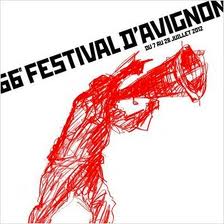
Actors loved him and he is credited with forming one of the best acting companies ever, with Maria Casarès, Jeanne Moreau, Philippe Noiret, Michel Bouquet and of course Gérard Philipe - all of whom played with him in Avignon. Today in its 66th season, the festival has grown beyond Vilar's wildest dreams and come to include a number of foreign directors (a third of all "In" plays this year are performed in a foreign language with French surtitles), and many original and avant-garde productions. Vilar famously wished the theatre to be considered a public utility, just like gas and electricity. The month-long artistic effervescence in Avignon with its thousands of devotees seems testimony to the fact that culture, including popular theatre, is indeed an essential human need.

We have four more operas to go and as many plays in Avignon as we can pack in before the end of July and hopefullly before Mr. Roubini's predicted blowup.

DSK-SINCLAIR

Another blowup − although one of lesser consequence to all of us − is the end of the Strauss-Kahn-Sinclair marriage that was announced by AFP and the French daily Libération on July 2nd, just days after the Strauss-Kahns had sued French gossip magazine Closer for invasion of privacy when they published a similar claim. Sources close to the couple have apparently confirmed that after 20 years of marriage Strauss-Kahn and Sinclair have been living separately in Paris for nearly two months now. 


This is another setback for DSK who is still facing serious legal problems in France and the United States. Although Sinclair's decision to leave him seemed predictable and inevitable, I confess to a pinch of pity for this brilliant modern-day Icarus. I know, I know, it's his own fault, and yet... This must be what the Stockholm Syndrome is like.


(*) For more on this Economic Forum, click here:

Monday, July 2, 2012

SUMMERTIME, FESTIVAL TIME

OPERA, JAZZ, ROCK AND THEATRE

Summer means Opera in Aix-en-Provence. Six operas are performed here during the month of July (two world premières), and this year Master Classes for Voice, Chamber Music, and Direction (mise-en-scène) are held three times a week from mid June throughout July as part of the opera program. Also this month, the town of Orange presents two operas as well as Mozart's Requiem, all staged in front of the majestic backdrop of the Roman wall of the Théâtre Antique.

Opera in Orange

It's heaven for those who like opera, but for those who don't there are many other musical offerings in the area, such as Les Nuits d'Istres with the great Jessye Norman who will sing jazz, blues and gospel, and artists such as Gilberto Gil and George Benson.


In Marseilles "Jazz from the Five Continents" presents saxophonist Sonny Rollins, the band Earth Wind and Fire, and more. The Roman arena of Nîmes hosts Bob Dylan and Elton John, as well as the English group Radiohead, and the tiny island of Gaou just off the Riviera coast features Sting, Gossip (remember the fat girl at the Cannes Film Festival?) and Ben Harper.


Piano festival in La Roque d'Anthéron


This year, the international piano festival in La Roque d'Anthéron will pay tribute to one of its favorite and more frequent performers, pianist Brigitte Engerer, who was expected to play again this year but who died on June 23, 2012 at the age of 59.


THEATRE IN AVIGNON

Music lovers are particularly well served with summer festivities in Provence, but the most popular of all events may well be the annual Theatre Festival in Avignon (*) where during the sole month of July more than 1000 plays are produced in venues ranging from the vast courtyard of the Papal Palace to little makeshift theatres for some 30 spectators.

Palais des Papes, Avignon
Here you are likely to see big stars − most recently Jeanne Moreau and Juliette Binoche − in the major theatres at night, but also plenty of young talent during the daytime "Off" festival who may become tomorrow's big names. This year's Associate Artist is actor-director Simon McBurney, the first Englishman so honored, who will open the season at the Palais des Papes with The Master and Margarita based on the novel by Mikhail Bulgakov.


To give you a little taste of these festivals, here's a chapter from my book Taking Root in Provence:


OPERA FESTIVAL

The Opera Festival in Aix-en-Provence is the local highlight of the year, and as opera lovers we consider ourselves fortunate to be living here. The fun starts in early June when about three dozen young musicians arrive from all over the world for Master Classes—an honor they have won in an international competition. These master classes are open to the public and are a wonderful opportunity to see up close the hard work and the difficulty of the art of singing, cello playing, violin, piano, etc. Some of our past masters have included Isaac Stern for violin, Teresa Berganza for voice, and Pierre Boulez for percussion and conducting, but every year brings an interesting new crop. Some of the young singers may perform in the chorus of the operas to be performed in July, but all will give recitals and concerts in one or more of the lovely squares and courtyards in the old center of Aix in the evenings. A €15 “passport” gives access to all master classes and concerts during the month of June as well as to some dress rehearsals.
            The serious excitement starts in July with the opening of the Opera Festival. Six operas are performed throughout the month in four different locations, and the city literally fills up with opera lovers. Hotels are full, as are restaurants and the terraces along the Cours Mirabeau—the Champs Elysées of Aix-en-Provence.
            With a bit of luck you run into stars, but you don’t need any luck to see famous faces in line at the various venues. I have made it a habit to have dinner at one of the two outdoor restaurants on the Place de l’Archeveché before the opera. With my tickets safely in my pocket, I can take my time to eat and watch the crowd gathering while I savor my dessert. I am sure to see current or former government ministers, well-known newscasters and other famous faces of politics and television, and even Gérard Depardieu with Carole Bouquet. Most of them have summer houses in the area and the air snaps with air kisses as they find each other and thrill at seeing and being seen.
            Opera tickets go on sale in early February, and living steps away from the box office you might think that getting tickets is a cinch for us. Well, not quite. There are  a limited number of inexpensive, subsidized tickets that sell out fast, and in hopes of getting any of these you have to get up early. Very early (*). When Oscar got in line at 3:30 in the morning (the box office opens at 10:00 AM) he was number sixty-five in the queue, and when I replaced him at 7:00 AM the line curled around the block. I recognized a number of stalwarts from previous years and found the same convivial atmosphere of shared hardship in anticipation of our reward. Some people sat on little stools wrapped in blankets, others in heavy coats with woolen scarves halfway up their faces stamped their feet to keep warm, some read, others chatted. Snippets of family life floated on the still night air, and once in a while some lucky “liner” would be relieved by a mate and allowed to go home and to bed.
            Surprisingly, people seem to be getting up earlier every year and this time there were two couples who had camped out all night with folding chairs and sleeping bags to be first in line the next morning. Perhaps not unusual for a rock concert but this is a crowd of retirees with many a grandmother among them. Tough little grandmothers who will wait stoically in the February night for seven to eight hours so that they can get tickets for themselves or a beloved grandchild at the affordable price of €28 (approx. $40). For those of us who buy everything, i.e., all six operas, these inexpensive tickets are manna from heaven.
            Around 9:00 AM “breakfast” appeared in the form of trays of croissants and hot coffee, tea and orange juice, offered free of charge by the Office de l’Opéra to the chilled ticket line. It thawed the frozen crowd and sparked a palpable sense of excitement and anticipation. The end was in sight, the prize within reach, and the ordeal almost over. Another long night had been offered to the opera gods who would soon reward our devotion. Murmurs of “See you next year” were beginning to be heard and all of us bound for a night by our shared passion for opera were soon to disperse for another year. Perchance to meet again at one of the performances, where with a knowing wink we would proudly pat the “cheap” ticket in our pocket before finding our places among the expensive Orchestra seats. We can’t suppress a secret feeling of superiority over all those who paid full price, before we sit down to enjoy Wagner’s Walkyrie with Sir Simon Rattle and the Berlin Philharmonic (no less), or Mozart, Monteverdi, or Janacek. Forgotten the long wait in the chilly night. What long wait?!

(*) Today some tickets are sold by telephone and Internet.


(*) To read the chapter about the Off Festival in Avignon featured in Taking Root in Provence, click here.


Monday, June 25, 2012

FETE DE LA MUSIQUE, NEW BOOK ON HOLLANDE CAMPAIGN


FETE DE LA MUSIQUE

Thirty years ago, then Minister of Culture Jack Lang introduced the Fête de la Musique in France, to be celebrated on June 21st, day of the summer solstice. Musicians of all kinds and all ages -- from symphony orchestras to one-man bands -- take over the city streets and play throughout the night to the delight of enthusiastic crowds. This popular event was soon adopted elsewhere and today is known as World Music Day in 32 countries worldwide.


This year for the first time since its inception, musicians in Aix-en-Provence were required to obtain a license to play at the Fête and were then given a designated spot to perform. Thus, the Orchestre Philharmonique du Pays d'Aix had the Place de l'Archevêché all to itself while a hard-rock band set up its boom-boom boosters at a safe distance on the Cours Mirabeau. This was the city's solution to the cacophony of recent years when youthful enthusiasm and excessive amplification sometimes caused more pain than pleasure in some of the tighter parts of the old town with bands playing within feet of each other.

One other novelty this year:  the city appointed animators to mingle with the crowds and keep an eye out for drunkenness, while at the same time handing out free breathalizer tests, ear plugs and condoms. The condom part came as a surprise until I found out that AIDS Solidarity Day celebrated its 20th anniversary on June 21st this year. 


NEW BOOK ON HOLLANDE CAMPAIGN

A new book has just been published (21 June 2012) entitled "François Hollande President: 400 days behind the scenes of a victory." It is a photographic record of the campaign that identifies Stéphane Ruet as the photographer and Valérie Trierweiler as the journalist who wrote the photo captions.


Voices have already been raised that her captions lack the neutrality of the professional journalist and are too often written in the first person singular of the narrator who, of course, does appear in a number of photos herself. "He takes me in his arms, safe from view. I cry. He laughs," she comments on the last photo. Under a photo where a smiling François Hollande and Ségolène Royal appear side by side on a stage at a rally in Rennes, she writes: "Yes, the man I love had a woman before me. [...]  I have to live with it." Royal's response in news weekly Le Point: "That's an inversion of roles. It was me whose family was wrecked" (when Hollande left her for Trierweiler), adding that it was she who might have reason to carry a grudge.

Ségolène Royal and François Hollande at Rennes rally

At the Rennes rally Hollande gave his supporter Ségolène a peck on the cheek, whereupon Trierweiler whispered to him : "Kiss me on the lips" and Hollande dutifully complied. The film of this scene was commented on by lip readers and the "Embrasse-moi sur la bouche" moment made the rounds of all news channels.

Trierweiler has not been heard from since her tweet and the prime minister's advice of greater discretion, but now that her jealousy is a matter of record she has lost credibility as a commentator on the political scene and even as an impartial observer.

Ségolène Royal, on the other hand, is picking up the pieces after her unexpected defeat in La Rochelle and will certainly be looking at a comeback of sorts. She has survived some tough battles before and managed to come out victorious after the Trierweiler attack by winning the sympathy of a majority. Quipped one observer: "Trierweiler has managed what nobody could before:  to make Ségolène Royal likeable."

These two strong characters are bound to cross paths again. Hollande may be well advised to step out of the way when they do.


Monday, June 18, 2012

LEGISLATIVE ELECTIONS, LE CESAR


LES LEGISLATIVES

In the second round of the French legislative elections on June 17th, the Socialist party won an absolute majority in Parliament which gives President Hollande a great boost in passing his announced reforms. The voting results contained some surprises, however.

Parti Socialiste in the pink

Old-timer and former Cultural Minister Jack Lang lost in Les Vosges, as did Marine Le Pen in her fiefdom of Hénin-Beaumont. Both were narrowly defeated, while young Marion Maréchal-Le Pen, Marine Le Pen's niece and Jean-Marie Le Pen's granddaughter, won convincingly in the Vaucluse. At 22, this law student became the youngest member of Parliament in France's history. François Bayrou, former presidential candidate and founder of the centrist MoDem party, lost out to the socialist challenger in a three-way battle in his district of Pyrenées-Atlantiques.


But the most shocking defeat was surely suffered by Ségolène Royal in La Rochelle, where she was soundly beaten in the second round by local dissident socialist Olivier Falorni who had refused to step aside in her favor. The outcome was no surprise and was generally seen as a tactical error by Royal and socialist party leaders for having catapulted her into Falorni's territory where this "diktat" by Paris was not appreciated.
A defeated Ségolène

It was a heavy blow for Royal who called this a betrayal by Falorni who won with substantial help of the center-right UMP party whose candidate had lost in the first round and was happy to block Royal's expected nomination as Speaker of the National Assembly. Seventy-five percent of Falorni's votes in La Rochelle came from the right, said Royal, which disqualifies him as a left-wing candidate.

The bombshell Twitter message from Valérie Trierweiler, François Hollande's partner, in support of Falorni certainly did not help but could not be blamed for this upset. It simply added to the miseries of Ségolène Royal whose partner of 30 years and father of her four children left her in 2005 for current girlfriend Valérie Trierweiler. Nevertheless, Royal supported Hollande throughout his presidential campaign, a favor Hollande returned when he declared his support for Royal in her face-off against Folarni -- thereby provoking Trierweiler into a fit of jealousy. Politics in France just got a little bit more complicated.


CESAR IS BACK!

Remember the story of the withdrawal of Marseille's old ferry boat Le César in 2008?  (blog of 9/23/11). It was replaced in 2010 by a catamaran named Le Ferry Boat.  [Yes, Ferry Boat is its name, which the locals pronounce ferry bo-AHT].

Le César back in service

The chug-a-lug César (named after the Marcel Pagnol character) had been making the short 900-ft crossing between the north and south banks of the Vieux Port for 55 years before age caught up with it and made it unsafe. The municipality decided that new technology was called for and introduced a sleek solar-powered catamaran that soon proved unable to handle the mistral wind and had to be retired from ferry duty. Red-faced City Fathers promised a solution and -- surprise! -- this week announced the return of Le César which after an extensive renovation had just passed its last test and was found fit to resume ferry service soon. But first it will be moored in front of City Hall in the Vieux Port as part of the Marcel Pagnol trilogy that actor/director Daniel Auteuil is adapting.

MUCEM
The catamaran will be assigned a new job of taking passengers from Le Vieux Port to the new MUCEM (Musée des Civilisations de l'Europe et de la Méditerrannée) a short distance away along the same bank, thereby avoiding the sideways gusts of wind that can apparently incapacitate it during a crossing.

The people of Marseilles are happy to welcome old César back, which to them was as much part of Marseilles as the cable car is part of San Francisco. Even if the catamaran shaved some two minutes off the crossing time, what's that to a Marseillais? Remember their motto: "Doucement le matin, pas trop vite le soir." (*)


(*) To read about Marseilles in Taking Root in Provence, click here


Wednesday, June 13, 2012

TRIERWEILER'S TWEET


Tweetweilergate

Valérie Trierweiler, President Hollande's partner, has created a political storm at a delicate time for the socialist party which is currently trying to obtain a parliamentary majority in the on-going legislative elections that will be decided on Sunday, June 17th. Ségolène Royal, Hollande's ex and mother of his four children, is running for re-election in the district of Poitou-Charentes where she faces a rival from her own socialist camp: Olivier Falorni. The first round was won by Royal with 32% against 29% for Falorni, but when party leaders asked him to step aside in favor of Royal he refused. The losing center-right candidate in this three-way contest has now given her backing to Falorni, which makes a win by Royal in the second round very difficult. In this context, president Hollande gave his public support to Ségolène Royal (who had been an unfailing supporter in his run for the presidency) but within hours a reportedly furious Valérie sent out a Twitter message supporting Ségolène's rival Olivier Falorni.

The players: Trierweiler, Falorni, Royal, Hollande

The left-wing daily Libération published a picture of Trierweiler under the heading "France's First Gaffe" while others questioned the "normalcy" of François Hollande who finds himself embroiled in a far from normal situation that can only have a negative impact on his image.


The Right is making the most of the situation, sniggering about The War of the Roses and Vaudeville coming to the Elysée, while Le Figaro states that Trierweiler's tweet has sown amazement and confusion in the socialist ranks with possibly "heavy consequences." But at the socialist party nobody is laughing. So far no official comment from Ségolène Royal other than that she wants to keep the focus on her campaign, and nervous silence from the Elysée. Barely one month into his presidency, Hollande is facing his first crisis − one not resulting from political and financial problems in the Euro-zone or beyond, but from a nasty domestic spat.

There is much at stake for Ségolène Royal who, after her presumed victory in the parliamentary elections, was promised the job of Président de l'Assemblée Générale (Speaker of the House). Her chances to get that position may have been seriously damaged. The latest polls today, June 13, indicate that Falorni has taken the lead from Royal and is currently set to beat her with 58% to her 42%.
Hold your breath until Sunday.

Sunday, June 10, 2012

PEOPLE, AUTHORS, ARCHEOLOGICAL FINDS, ETC.

PEOPLE 

Valérie Trierweiler
domestic partner of French President François Hollande, will continue to work as a journalist for Paris Match magazine but will switch from political reporting to covering Art and Culture. In a little dig at her critics she opened her first article, a book review of "Eleanor Roosevelt, First Lady and Rebel" by stating: "How about that? A journalist First Lady is nothing new!" pointing out that Eleanor Roosevelt, mother of six, had written freelance articles for a number of publications before beginning her daily syndicated newspaper column on life at the White House, which she continued writing until her death. Clearly identifying herself with Eleanor Roosevelt, Trierweiler goes on to say that Franklin Roosevelt's wife had an independent nature and allowed herself to disagree with her husband on certain issues. In an interview with a fellow journalist, Trierweiler has also said: "As a mother of three, my job is vitally important to me. I have to earn a living and, besides, it's a form of normality."

The couple Strauss-Kahn

As former IMF Director Dominique Strauss-Kahn continues to battle his legal problems in France and the United States, a book has just been published (8 June 2012) about the private life of DSK and his wife, journalist Anne Sinclair. Titled Les Strauss-Kahn and written by two female journalists of the newspaper Le Monde, the book reveals that on a personal level Dominique Strauss-Kahn and Nicolas Sarkozy were closer than generally known. They shared a number of wealthy friends from the business world and from both sides of the political spectrum, and frequented each other's homes from time to time. Nevertheless, Sarkozy knew all the rumors about DSK's sexual exploits and was kept well informed by police sources of his regular visits to Parisian sex clubs as well as an incident in a steamed-up car in the Bois de Boulogne containing DSK and several partners. These reports were carefully kept under wraps but the decision was made to send high-risk Strauss-Kahn off to the IMF in Washington and away from the political fray in France for a while, reportedly with a warning from l'Ami Sarkozy to watch his ways because "Americans won't go for this."

Sarkozy as well as many other political figures in France were convinced that DSK's womanizing and his libertine lifestyle would stand in the way of his ever being elected as president of France in spite of his obvious professional qualities. One commentator compared Les Strauss-Kahn to Tom Wolfe's The Bonfire of the Vanities, the story of the fall of another Master of the Universe.

AUTHORS

I just attended a conference and book signing by Douglas Kennedy, successful American novelist, at my favorite English bookstore in Aix-en-Provence. As book signings go, this was a mob scene. Kennedy is an engaging speaker in English as well as French, and the fact that his novels were available in both English and French surely contributed to this success. Interestingly, the crowd was about evenly divided between youngsters and retirees, who all patiently waited in line to have their copy signed − a hopeful sign that not all young people have succumbed to the mania of reading only ebooks. 

Two weeks ago this same bookstore welcomed Canadian author Joseph Boyden, one of my favorite young writers (check out his "Three Day Road"- beautiful!). I had met him two years ago at a literary festival in the village of Fuveau near Aix where a French publishing house hosted its authors under the banner of "American contemporary literature" but exclusively in the French translation. During interviews, Boyden, Marilynne Robinson, A.M Holmes and other invited authors were assisted by a French interpreter, but at the author table seated behind piles of their books with unfamiliar French titles they were sometimes heard to ask: "Which one is that? Oh, the blue one" before signing a particular book. No such problems at his book signing in Aix. 

MORE ARCHEOLOGICAL FINDS IN MARSEILLES

Sarcophagi in Marseilles
When digging the excavation for the foundation of an apartment and office complex in the center of Marseilles earlier this year, the builder uncovered between six and eight tombs, one child-sized and the others over six feet long, which were thought to be of Greek origin. Scientists, who suspect but have yet to confirm that these are indeed Greek tombs dating from the 4th and 5th century BC, have expressed their surprise at the location of the find. According to one archeological expert: "Cemeteries were usually located outside the cities, which makes this discovery extremely interesting in the context of what we know about the Greek occupation of the area at the time. We may have to revise our map." Whatever the final outcome, these sarcophagi are similar to some found in nearby areas, with funerary urns and ashes inside, and as such are a major discovery.

LEGISLATIVE ELECTIONS


Today, June 10th, is the first round of the 2-round legislative elections in France, where the socialist government of François Hollande hopes to gain a majority in Parliament. He will most certainly need that to push through a number of the reforms he has announced with as yet unspecified funding. The next round will take place on June 17th. Stay tuned...